⚡ Quick Answer: What Is Passive Investing?
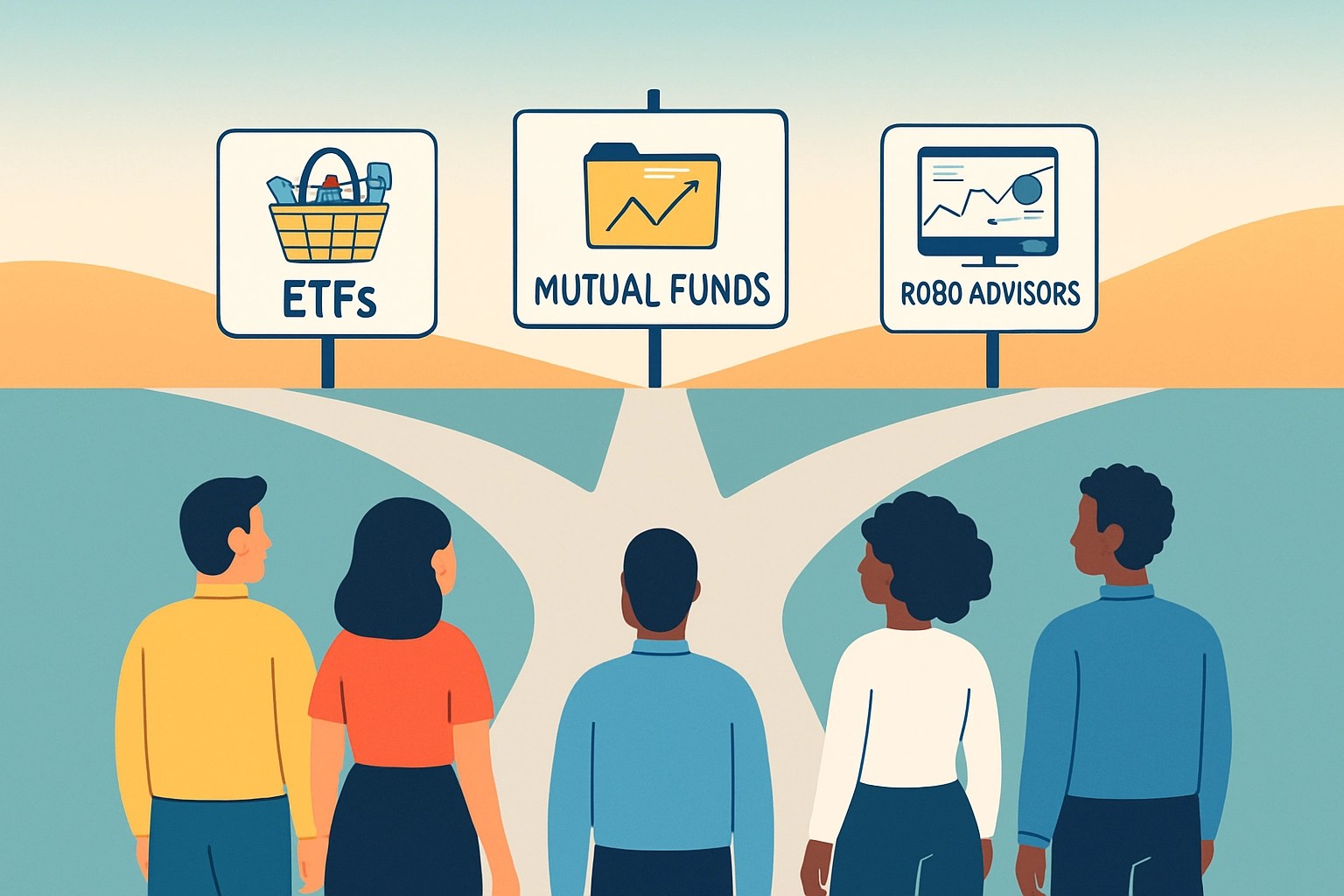
Passive investing means putting your money into low-cost funds that track the market automatically, without trying to pick individual stocks. The three most beginner-friendly tools are ETFs (Exchange-Traded Funds), index mutual funds, and robo-advisors. Each one gives you instant diversification, lower fees, and a proven path to building long-term wealth.
📋 What You’ll Learn in This Guide
Stop Stressing About Stocks – There Is a Simpler Way
If you have ever felt paralyzed trying to figure out which stocks to buy, you are not alone. Most beginners are told to “just invest” without being shown a clear, simple path. The good news is that you do not need to analyze earnings reports or follow financial news every day to build real wealth.
Passive investing through ETFs, mutual funds, and robo-advisors gives you a straightforward, proven approach that has helped millions of everyday investors grow their money over time. This guide will break down each option in plain language so you can choose what fits your life and get started with confidence.
The Core Idea: Why Passive Investing Works
If you are completely new to investing, it helps to start with the fundamentals. Our Investing for Beginners guide covers the basics of how the market works before you dive into specific tools.
Passive investing is built on one simple insight: over the long run, the market tends to go up. Instead of guessing which individual company will win, passive investing lets you own a small piece of everything – so you benefit no matter which company comes out on top.
Diversification is the key principle here. When you spread your money across hundreds of companies or assets, one bad investment cannot sink your entire portfolio. If you own stock in just one airline and it goes bankrupt, you lose everything. If you own a fund that holds 500 companies, one bankruptcy barely moves the needle.
Lower fees matter more than most people realize. Actively managed funds often charge 1% or more per year. Index funds and ETFs often charge 0.03% to 0.20%. Over 30 years, that difference in fees can cost you tens of thousands of dollars in lost compound growth.
The 3 Best Passive Investing Options for Beginners
1. ETFs (Exchange-Traded Funds)
An ETF is a basket of assets stocks, bonds, or both that trades on a stock exchange just like a regular stock. When you buy one share of an ETF like VOO (Vanguard S&P 500 ETF), you instantly own a tiny piece of all 500 companies in the S&P 500.
- What it is: A ready-made, diversified portfolio in a single investment.
- Why it works: Low annual fees, flexible trading, and broad diversification in one purchase.
- Who it’s for: Beginners who want control over when they buy and sell, and want to keep costs as low as possible.
2. Index Mutual Funds
A mutual fund pools money from many investors to buy a collection of securities. Index mutual funds are the beginner-friendly version instead of a fund manager trying to beat the market (and usually failing), these funds simply track an index like the S&P 500 or total stock market.
- What it is: A pooled investment fund that automatically mirrors a market index.
- Why it works: Simple to automate, great for recurring monthly investments, and very low fees with index versions.
- Who it’s for: Beginners who want to set up automatic monthly contributions and forget about it.
3. Robo-Advisors
A robo-advisor is a digital platform that builds and manages a portfolio for you based on your goals and risk tolerance. You answer a few questions, deposit money, and the platform handles everything including rebalancing your portfolio when it drifts off track.
- What it is: An automated investment service that manages a portfolio of low-cost ETFs on your behalf.
- Why it works: Completely hands-off, beginner-friendly interface, and most offer tax-loss harvesting to reduce your tax bill.
- Who it’s for: Beginners who want professional-level portfolio management without doing any of the work themselves.
ETFs vs. Mutual Funds vs. Robo-Advisors: Side-by-Side
| Feature | ETFs | Index Mutual Funds | Robo-Advisors |
|---|---|---|---|
| Trading | Throughout the day | Once daily after market close | Automatic |
| Management | Passive (you manage) | Passive (you manage) | Automated algorithm |
| Annual Fee | 0.03%–0.20% | 0.00%–0.20% | 0.25%–0.50% + ETF fees |
| Minimum to Start | $1–$50 (fractional shares) | $0–$3,000 depending on fund | $0–$500 depending on platform |
| Best For | Flexibility + lowest cost | Auto monthly investing | True hands-off approach |
| Tax Efficiency | High | Moderate | High (with tax-loss harvesting) |
Step-by-Step: How to Start Passive Investing Today
- Set a clear goal. Decide what you are investing for – retirement in 30 years, a house in 10 years, or general wealth building. Your goal determines how much risk you should take on.
- Build a small emergency fund first. Before investing, make sure you have 1–3 months of expenses saved in a high-yield savings account. Our emergency fund guide walks you through this step by step. Investing money you might need soon is one of the most common and costly beginner mistakes.
- Choose a platform. Pick one of the beginner-friendly options listed below based on your preferred approach. There is no wrong answer – the best platform is the one you will actually use.
- Open and fund your account. Most platforms let you open an account in under 10 minutes. Link your bank account and make your first deposit. Start with whatever you can afford – even $25 or $50 matters.
- Pick your investment. For ETFs or mutual funds: a total stock market fund or S&P 500 index fund is a solid, simple choice for most beginners. For robo-advisors: just answer the onboarding questions honestly and let the algorithm decide.
- Set up automatic contributions. This is the most powerful step. Set up a recurring monthly transfer — even $50–$100 — so investing becomes a habit you never have to think about.
- Leave it alone and review once a year. Passive investing rewards patience. Check your account annually and resist the urge to sell when the market dips.
Beginner-Friendly Platforms to Get Started
| Platform | Best For | Minimum | Key Benefit |
|---|---|---|---|
| Fidelity | ETFs + Index Mutual Funds | $0 | Zero-expense-ratio index funds |
| Vanguard | Long-term index investing | $0 ETFs / $1,000 mutual funds | Pioneer of low-cost index funds |
| Betterment | Robo-advisor | $0 | Automatic rebalancing + tax-loss harvesting |
| Wealthfront | Robo-advisor | $500 | Advanced tax optimization features |
| Charles Schwab | ETFs + full brokerage | $0 | Excellent educational resources |
Note: Fees and features change regularly. Always verify current offerings directly on each platform before opening an account.
5 Common Mistakes Beginners Make (And How to Avoid Them)
1. Waiting until you have “enough” money. There is no perfect time to start. The earlier you invest, the more time compound growth has to work. Start with $25 if that is what you have.
2. Choosing actively managed funds without realizing it. Many funds sound like index funds but are actively managed and carry fees 5–10x higher. Always check the expense ratio before investing – anything above 0.50% deserves a second look.
3. Panic-selling during market downturns. Markets drop regularly sometimes dramatically. Selling when prices fall locks in your losses. Historically, staying invested through downturns has always been the right move for long-term investors.
4. Not automating contributions. Relying on yourself to manually invest each month means you will skip months. Automation removes the decision entirely and builds wealth on autopilot.
5. Investing money you need soon. The stock market can lose 30–40% of its value in a bad year. Only invest money you will not need for at least 3–5 years. Keep short-term savings in a high-yield savings account instead.
Pro Tips for Building Long-Term Wealth
- Use a tax-advantaged account first. If you have access to a 401(k) with an employer match or a Roth IRA, prioritize these before a regular brokerage account. The tax savings are significant.
- Keep it simple. One broad index fund – like a total stock market ETF – is all most beginners need to start. You can always add more complexity later.
- Ignore the noise. Financial media thrives on drama. Stock market predictions are unreliable. The data consistently shows that staying invested in low-cost index funds outperforms most active strategies over time.
- Reinvest your dividends and let compound growth do the heavy lifting. Most platforms offer automatic dividend reinvestment – turn it on from day one. If you want to understand why this matters so much, read our post on compound interest and how it makes your money work for you.
Frequently Asked Questions
What is the difference between an ETF and an index fund?
An index fund is a strategy – it tracks a market index like the S&P 500. An ETF is a structure – it trades on a stock exchange like a stock. Many ETFs are index funds, and many index funds come as ETFs. The main practical difference: ETFs trade throughout the day, while mutual fund index funds trade once per day after the market closes. For most beginners, the difference is minor.
How much money do I need to start?
Very little. Many brokerages now offer fractional shares, meaning you can buy a portion of an ETF for as little as $1. Robo-advisors like Betterment have no minimum balance. Index mutual funds at Fidelity start at $0 for certain funds. There is no reason to wait until you have a large lump sum.
Is a robo-advisor worth the extra fee?
It depends on how hands-off you want to be. Robo-advisors typically charge 0.25% per year on top of the ETF fees. For that fee, you get automatic rebalancing, tax-loss harvesting, and a portfolio matched to your goals. If managing your own ETF portfolio feels overwhelming, the fee is worth it. If you are comfortable making simple investment decisions yourself, a single low-cost ETF at Fidelity or Vanguard will save you money.
What if the market crashes after I invest?
Market downturns are normal and temporary. Every major crash in history has eventually recovered and reached new highs. The biggest risk is panic-selling at the bottom. If you are investing for a goal that is 5+ years away, a market crash early in your journey is actually an opportunity — you are buying more shares at a lower price.
Can I have both ETFs and a robo-advisor?
Absolutely. Many investors use a robo-advisor for most of their portfolio and a self-managed ETF account for learning purposes. There is no rule that says you must pick just one approach.
Your Next Step: Start Before You Feel Ready
The most important thing you can do is start – even imperfectly. A $50 investment in a low-cost index ETF today is worth more than a “perfect” strategy you never actually implement.
Here is your simple action plan: open a free account at Fidelity, Vanguard, or Betterment this week. Deposit whatever you can afford. Choose a total stock market or S&P 500 fund. Set up a recurring monthly contribution. Then let compound growth do its job.
You do not need to be a finance expert to build wealth. You just need to start, stay consistent, and keep your costs low. That is the entire strategy.
Leave a Reply