⚡ Quick Answer
Compound interest means you earn interest on your money and on the interest you have already earned. Over time, this turns small savings into serious wealth — especially if you start early. It is the most powerful money tool a beginner can use.
📋 In This Guide
Have you ever heard the phrase, “Make your money work for you”? It sounds like a secret only rich people know. But it is not a secret at all. It is a simple idea called compound interest.
Compound interest is the single most powerful tool for building wealth. It is the engine that helps everyday people grow real money over time. If you are a beginner or a young adult, understanding this concept is the first step toward financial independence.
Let’s break it down in the simplest way possible.
1. What Is Compound Interest?
When you put money into a savings account or investment, you earn interest. That is your return. But there are two kinds of interest – and they are very different.
Simple Interest
💵
You earn interest only on your original deposit. Your balance grows at the same rate every year. Predictable — but slow.
Compound Interest ✨
📈
You earn interest on your original money AND the interest already earned. It is “interest on interest” — and it accelerates over time.
The simple definition: Compound interest is interest earned on both your initial investment and on the interest you have already earned — period after period.
2. How Does Compound Interest Work?
Imagine you start with $100. You earn 10% interest in year one. Now you have $110.
In year two, you do not just earn interest on the original $100. You earn interest on the full $110. The $10 you earned in year one starts earning money too.
This cycle repeats again and again. Your money grows faster and faster because the base keeps getting bigger. It is like a snowball rolling down a hill – it picks up more snow with every turn.
3. The Magic of Time: Why Starting Early Wins
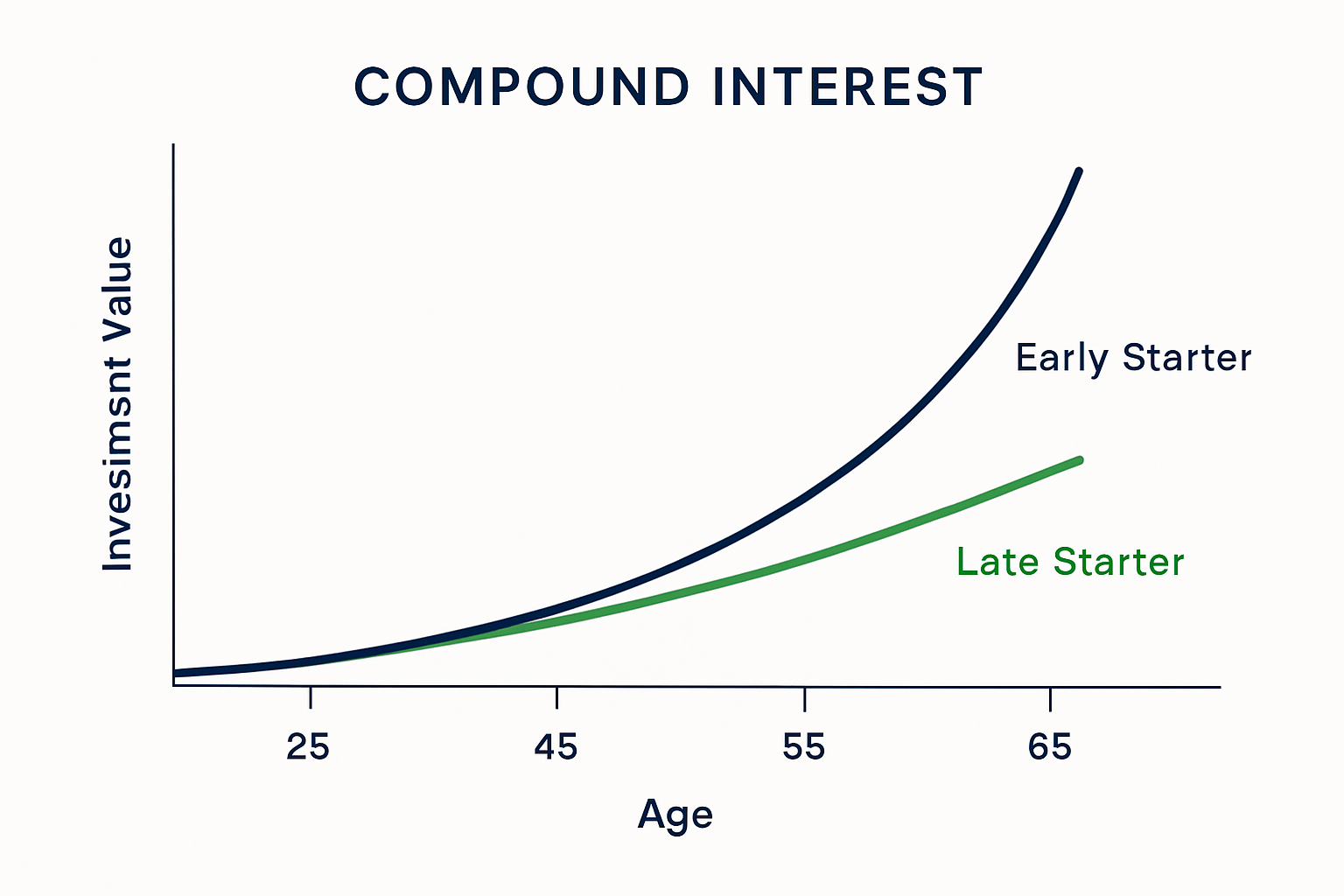
Time is the most important ingredient in the compound interest recipe. The longer your money has to grow, the more dramatic the results. This is why starting in your 20s is a huge advantage.
It is not about how much you put in.
It is about how long you let it grow. ⏳
This is also why getting the rest of your finances in order matters so much. If debt or lack of savings is keeping you from investing early, those are the first things to fix. A solid emergency fund protects your investments so you never have to pull money out early.
4. The Tale of Two Investors
Let’s look at two friends – Sarah and Mark. Both earn a 7% annual return on their investments.
🌱 Sarah
The Early Starter
📅 Starts: Age 25
⏹ Stops: Age 35 (10 years)
💵 Per year: $2,000
🏦 Total invested: $20,000
At 65: $260,000
⏳ Mark
The Late Starter
📅 Starts: Age 35
⏹ Stops: Age 65 (30 years)
💵 Per year: $2,000
🏦 Total invested: $60,000
At 65: $227,000
🏆 The Result
Sarah invested $20,000 for just 10 years. Mark invested $60,000 for 30 years.
Sarah ends up with $33,000 more — despite investing $40,000 less.
Her 10-year head start did all the heavy lifting. That is compound interest + time working together.
📊 Final Wealth at Age 65
$260,000
$227,000
Both earn 7% annual return. Difference = 10 years of compounding.
Once you understand this, the natural next question is: where should you actually invest? A good starting point is reading about ETFs, mutual funds, and robo-advisors – three beginner-friendly options where compound interest quietly works in the background for you.
5. Consistency, Not Quick Wins
This process is not about getting rich overnight. It is about steady, boring consistency. You do not need to find the next hot stock. You need to keep putting money in and let time do the heavy lifting.
🔁
Automate It
Set up automatic contributions on payday. Remove the decision from your hands.
📅
Stay Regular
Even small, regular contributions add up to huge amounts over decades.
🙅
Don’t Touch It
Withdrawing early breaks the compounding chain. Let time do its job.
The key is to automate your savings and investments. Make it a habit. This consistent approach is the foundation of long-term wealth building. But consistency only works when your money is not being eaten by impulse spending. If that is a challenge, read this guide on how to stop impulse buying and save more money.
Also worth reading: Before you invest, make sure you have a budget in place. The 50/30/20 budgeting rule is the simplest way to free up money to put compound interest to work every month.
6. Your Compound Interest Questions Answered
❓ What is compound interest?
It is interest earned on both your initial investment and on the accumulated interest from previous periods. It is “interest on interest” — and it accelerates with time.
❓ How does compound interest work?
Your investment grows because the interest you earn is added back to the original amount. That larger amount then earns even more interest next period. Each cycle builds on the last.
❓ Why is compound interest important?
It is the engine of wealth growth. It lets your money multiply exponentially over time. It is the most effective way for everyday people to reach financial independence — no high income required.
❓ How long does compound interest take to grow money?
It works best over long periods — typically decades. The growth feels slow at first but accelerates dramatically after 10 to 15 years. Time is your biggest asset.
❓ Where can I actually use compound interest?
High-yield savings accounts, index funds, ETFs, and retirement accounts all use compound interest to grow your money. Start with a simple, low-cost option. The account matters less than starting early.
7. Your Next Step
🌱 Practical Takeaway
The money you earn today is not just money. It is a seed that can grow into a forest. The earlier you plant it, the bigger the forest will be.
⚡ One Simple Action
Open a high-yield savings account or a basic investment account today. Even if you only put in $25, you have started the clock on compound interest. You have put your money to work.
Not sure where to start investing? Read the beginner-friendly guide to investing for beginners – it covers exactly what to do with your first dollar.
Start the Clock Today 🚀
The best time to start was 10 years ago. The second best time is right now. Pick one of these next steps and take action today.
Leave a Reply