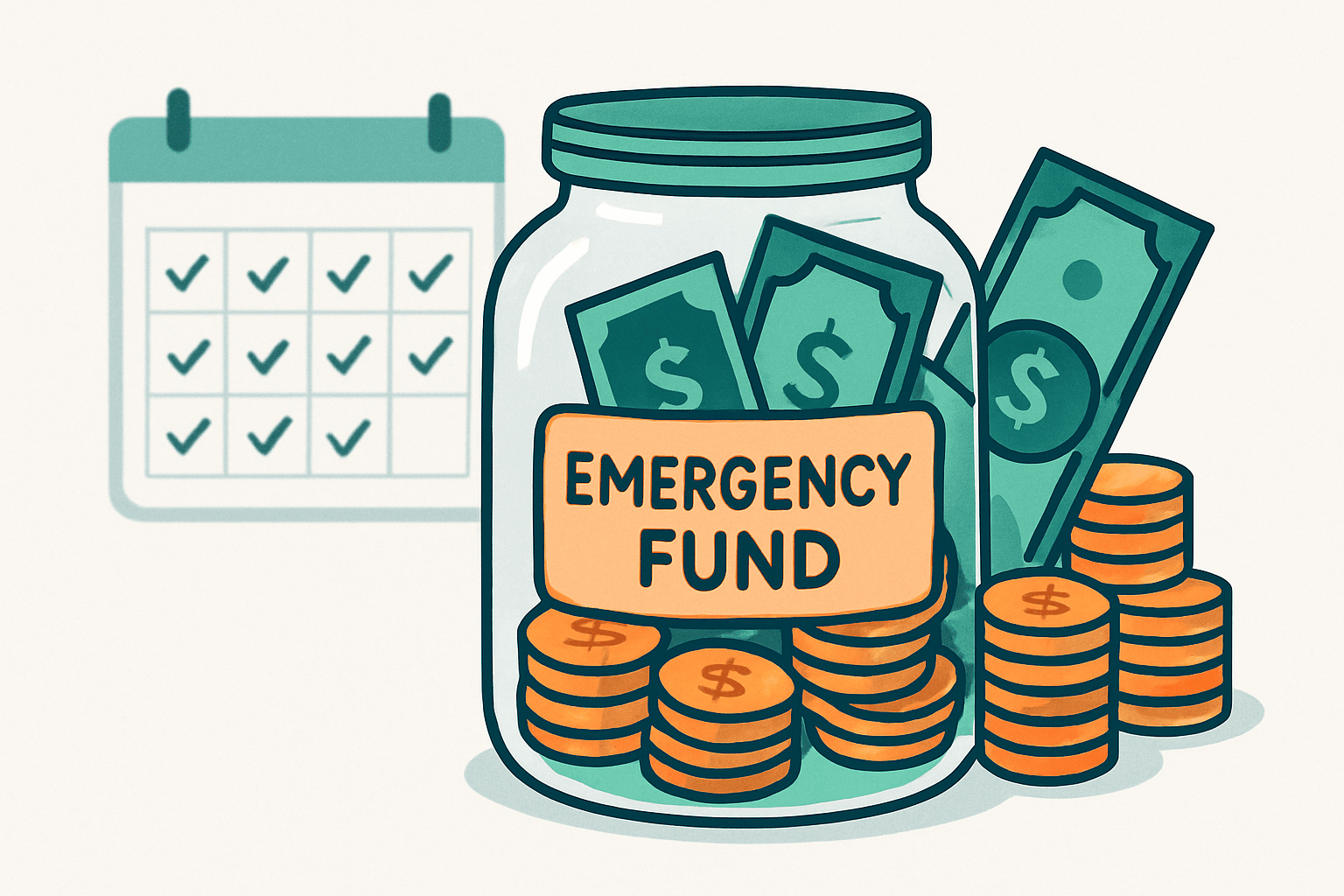
Picture this:: Your car breaks down, or you get an unexpected medical bill. Could you cover a $1,000 emergency in cash right now? If you’re like 43% of Americans, especially many Millennials and Gen Z, the answer is no [1]. This often leads to high-interest debt and stress.
You can start changing that in 30 days.
This guide shows you how to build your first $1,000 emergency fund in 30 days. You’ll learn how much to save, where to keep it, and how to find extra money fast — even if you’re starting at zero.
What Is an Emergency Fund and Why Do You Need One?
Before the 30-day plan, let’s define the basics. An emergency fund isn’t just a vague savings account; it is a specific tool with a specific purpose.
What Counts as a Real Emergency?
A true emergency is unexpected, necessary, and urgent. It is not a “sale at my favorite store” or a “last-minute trip to Vegas.”
| Is it an Emergency? | Example | Action |
| Yes | Job loss or reduced hours | Use the fund for rent/groceries |
| Yes | Major car repair (needed for work) | Use the fund to stay mobile |
| Yes | Urgent medical or dental bill | Use the fund for health |
| No | New iPhone launch | Save separately in a “Tech Fund” |
| No | Holiday gifts | Use a “Sinking Fund” |
| No | Impulse buying a flight | Check your “Travel Budget” |
Tip: Controlling impulse spending protects your emergency fund.
How Much Should You Save in an Emergency Fund?
A fully funded emergency fund (3–6 months of expenses) can feel overwhelming when you’re starting at zero. That’s why we start with a Starter Emergency Fund.
For most people, $1,000 is a practical first goal. It can cover many common expenses, like car repairs or a broken laptop. Once you hit $1,000, you’ll have the momentum to go for the full 3–6 month cushion.
Where Should You Keep Your Emergency Fund in 2026?
A standard checking account is not ideal for an emergency fund. You want your money to be liquid (accessible) but separate from your spending cash.
The best home for your fund is a High-Yield Savings Account (HYSA).
- Why? As of early 2026, top HYSAs (like Varo, Vio Bank, or American Express) are offering rates between 4.00% and 5.00% APY.
- The Benefit: If you have $1,000 sitting in a 5% APY account, you’re earning $50 a year just for letting it sit there. Traditional big banks might only give you $0.10.
The 30-Day Emergency Fund Challenge (Step-by-Step Plan)
Ready to get started? This four-week plan is designed to take you from $0 to your first few hundred dollars (or even your first $1,000) by combining small cuts with quick income boosts.
Week 1: The Foundation & Automation
The first week is about setting up the “pipes” so your savings happen automatically.
- Calculate Your Numbers: Use your “must-have” bills (rent, utilities, groceries, insurance) to find your monthly survival number. Multiply by 3 for your long-term goal. Our guide on The 50/30/20 Rule can help you categorize these.
- Open Your HYSA: Choose a bank with no monthly fees and a competitive rate. Pick a reputable online bank with no monthly fees and open the account today.
- The “Five-Dollar Rule”: Set up an automatic transfer of just $5 a day from your checking to your new HYSA. That adds up to about $150 in a month.
Week 2: The “Expense Audit” (Find $200 Fast)
This week, look for money you’re already spending.
- The Subscription Slash: Use an app or just scroll through your bank statement. Cancel that streaming service you haven’t watched in three months or the gym membership you don’t use. Potential Saving: $30–$70/month.
- The “Brown Bag” Challenge: For one week, commit to making coffee at home and packing every lunch. The average Gen Z worker spends $15+ on a workday lunch. Potential Saving: $75/week.
- The Utility Tweak: Unplug “vampire electronics” (like gaming consoles or old TVs) and lower your thermostat by 2 degrees. Potential Saving: $10–$20/month.
Week 3: The Income Boost (The Side Hustle Sprint)
This week, focus on generating quick cash. The goal is to make $200–$400 to rapidly boost your fund.
- Sell Unused Items: Declutter your space and list items you no longer need on platforms like Facebook Marketplace or Poshmark. Think old electronics, clothes, or furniture. Small sales still help.
- Quick Gigs: Dedicate a few hours this weekend to a simple side hustle. This could be pet sitting, delivering groceries, or completing online surveys. For more ideas, check out our dedicated guide: Easy Side Hustle Ideas for 2025/2026.
- Find “Hidden” Money: Check for forgotten cash-back rewards on credit cards or apps. You might have $20–$50 waiting to be transferred directly to your emergency fund.
Week 4: Habit Stacking & The Finish Line
By week 4, you should see your balance growing. Now, we make sure it stays that way.
- Review Your Progress: Look at your HYSA. Did you hit $500? $800? Acknowledge your progress.
- Increase the Automation: If you didn’t miss the $5/day from Week 1, try bumping it to $7 or $10.
- The “Windfall” Rule: Decide that any extra money tax refunds, gifts, or bonuses goes into your emergency fund until you reach your goal.
Part 3: Should You Save or Pay Off Debt First?
To keep your momentum going, you need to understand where this fits into your overall “Survival” and “Income” buckets.
The Survival Bucket: Debt vs. Savings
A common question for Millennials is: “Should I save for an emergency or pay off my student loans/credit cards first?”
Do both, and build the starter fund first.
Without a $1,000 cushion, any car breakdown will go straight onto your credit card, keeping you in the debt cycle. Once you have $1,000, focus on paying off high-interest debt.
Bonus: How to Keep Growing After Your First $1,000
Once you hit your $1,000 starter fund, your next step is simple: keep building toward 3–6 months of expenses.
At this stage, you can:
- Increase your automatic transfer.
- Add one small side hustle.
- Focus on paying down high-interest debt.
If you want deeper income strategies, check out our full Side Hustle Guide.
Part 4: Managing Your Fund Like a Pro
After you fund the account, protect it.
The “Is it an Emergency?” Checklist
Before you transfer money back to your checking account, ask yourself these three questions:
- Is it unexpected? (If you knew the car insurance was due in March, it’s not an emergency).
- Is it necessary? (Will your life or health be negatively impacted if you don’t pay this now?)
- Is it urgent? (Can it wait until your next paycheck?)
- If the answer to all three is “Yes,” use the fund. That’s its purpose. Refill it as soon as possible.
Common Pitfalls to Avoid
- Keeping it in your checking account: The temptation to spend it on a “good deal” is too high.
- Waiting for a “big” amount to save: Don’t wait until you have $500 to deposit. Deposit $5 today. Consistency beats intensity every time.
- Ignoring small wins: Saving $20 on your grocery bill is a win. Put that $20 directly into your HYSA immediately.
Part 5: What’s Next? (Moving to “Investing Lite”)
Once you’ve conquered the 30-day challenge and built your 3–6 month cushion, you move from stability to long-term growth. This is where you can start exploring Investing Lite. This focuses on long-term investing with simple strategies.
- The Power of Compound Interest: Compound interest means you earn returns on both your money and past returns. ” If you start investing $100 a month in your 20s, you’ll likely end up with hundreds of thousands more than someone who starts in their 40s—even if they invest more total money. Over time, it can significantly increase your savings.
- The Roth IRA (The “Tax-Free” Secret): For Millennials and Gen Z, the Roth IRA is arguably the best retirement tool. You contribute money after you’ve already paid taxes on it, which means when you withdraw it in your 60s, every single penny of growth is tax-free. If your $10,000 grows to $100,000, that growth can be withdrawn tax-free in retirement.
- Simple Index Funds (The “Set It and Forget It” Strategy): You don’t need to pick individual stocks allow you to own a tiny piece of the 500 biggest companies in the U.S. It’s diversified, low-cost, and historically returns about 7–10% annually over the long term.
- Employer Matching (The “Free Money” Rule): If your job offers a 401(k) match, that is 100% free money. Always contribute enough to get the full match before putting extra money anywhere else. That match doubles the amount you contribute up to the limit.
Check out our Investing for Beginners Guide to take the next step in your financial journey.
Conclusion: Your 30-Day Checklist
Building an emergency fund is one of the most empowering steps you can take for your financial health. It reduces the impact of unexpected expenses.
Building an emergency fund changes how you handle stress. Instead of panic, you have options. Instead of debt, you have cash. That shift improves long-term stability.
- Your Immediate Next Steps:
- Today: Open a High-Yield Savings Account.
- Today: Set up a $5/day automatic transfer.
- This Weekend: List 3 items for sale online.
Ready to take control? Start the challenge today and tag us with your progress!
Emergency Fund FAQs
How fast should I build an emergency fund?
As fast as possible without missing essential bills. A 30-day sprint helps build momentum.
Should I invest my emergency fund?
No. Your emergency fund should stay in cash inside a high-yield savings account. It must stay stable and accessible.
Can I use a credit card instead of an emergency fund?
No. A credit card is borrowed money with interest. An emergency fund is your money.
What if I have debt? Should I still save?
Yes. Build a $500–$1,000 starter fund first, then focus on high-interest debt.

[…] from turning into a new debt crisis. If you need help getting started, we have a great guide: Build Your First Emergency Fund. For more in-depth guidance on budgeting and financial planning, consider picking up a copy of The […]
[…] Build Your First Emergency Fund: A Step-by-Step Challenge […]
[…] 🏦BEFORE YOU INVEST The Ultimate Beginner Emergency Fund Guide (2026 Edition) → […]
[…] the financial goals checklist to map this out, and if you’re starting from zero, the guide on building your first emergency fund is the right place to […]
[…] or lack of savings is keeping you from investing early, those are the first things to fix. A solid emergency fund protects your investments so you never have to pull money out […]
[…] a high-yield savings account — not your checking account where it’s too easy to spend. Read this step-by-step emergency fund guide to get […]