Also Posted on Medium
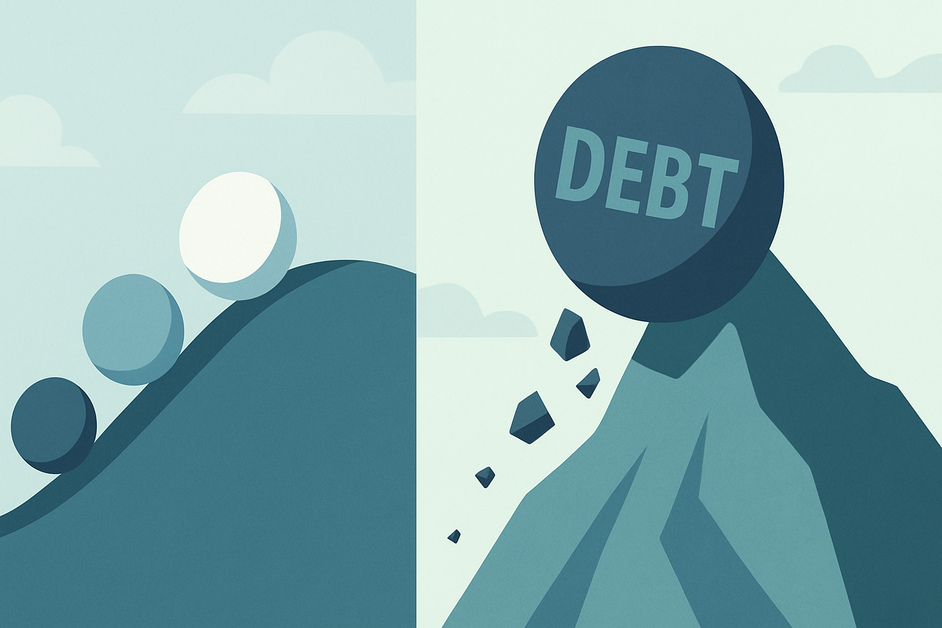
Let’s be honest: looking at a mountain of debt feels like trying to run a marathon with a backpack full of rocks. It’s heavy, it’s exhausting, and some days you just want to sit down and quit.
If you’ve ever stared at a credit card statement and felt that pit in your stomach, you’re not alone. The average household carries thousands in high-interest debt, and the hardest part isn’t the math it’s the mental fatigue of feeling like you’re getting nowhere. But here’s the good news: You don’t need a six-figure salary or a finance degree to fix this. You just need a plan that matches how your brain actually works. If you want to understand why behavior matters more than math, read The Psychology of Money: Better Spending Habits
Today, we’re breaking down the two heavy hitters of debt management: The Debt Snowball and The Debt Avalanche.One is for the “math people” who want to save every penny, and the other is for those of us who need a win right now to keep the fire alive.
Step 1: Face the Music (The “Debt Map”)
Before you can kill the dragon, you have to know how big it is. Grab a piece of paper, open a fresh spreadsheet, or use a simple notes app and list everything. No hiding under the rug this time! If you don’t already have a system for managing your monthly cash flow, start with the 50/30/20 Budgeting Guide for Beginners (2026) Creating this “Debt Map” is the most important part of any debt payoff strategy. It moves the debt from a scary, vague cloud in your head to a concrete list of numbers you can tackle.
Here’s an example of what a typical “Debt Map” looks like for a beginner:
| Debt Name | Total Balance | Interest Rate (APR) | Minimum Payment |
|---|---|---|---|
| Old Medical Bill | $450 | 0% | $50 |
| Store Credit Card | $1,200 | 26% | $40 |
| Personal Loan | $5,000 | 12% | $150 |
| Car Loan | $9,000 | 5% | $250 |
| Student Loan | $18,000 | 6.5% | $210 |
Strategy A: The Debt Snowball Method
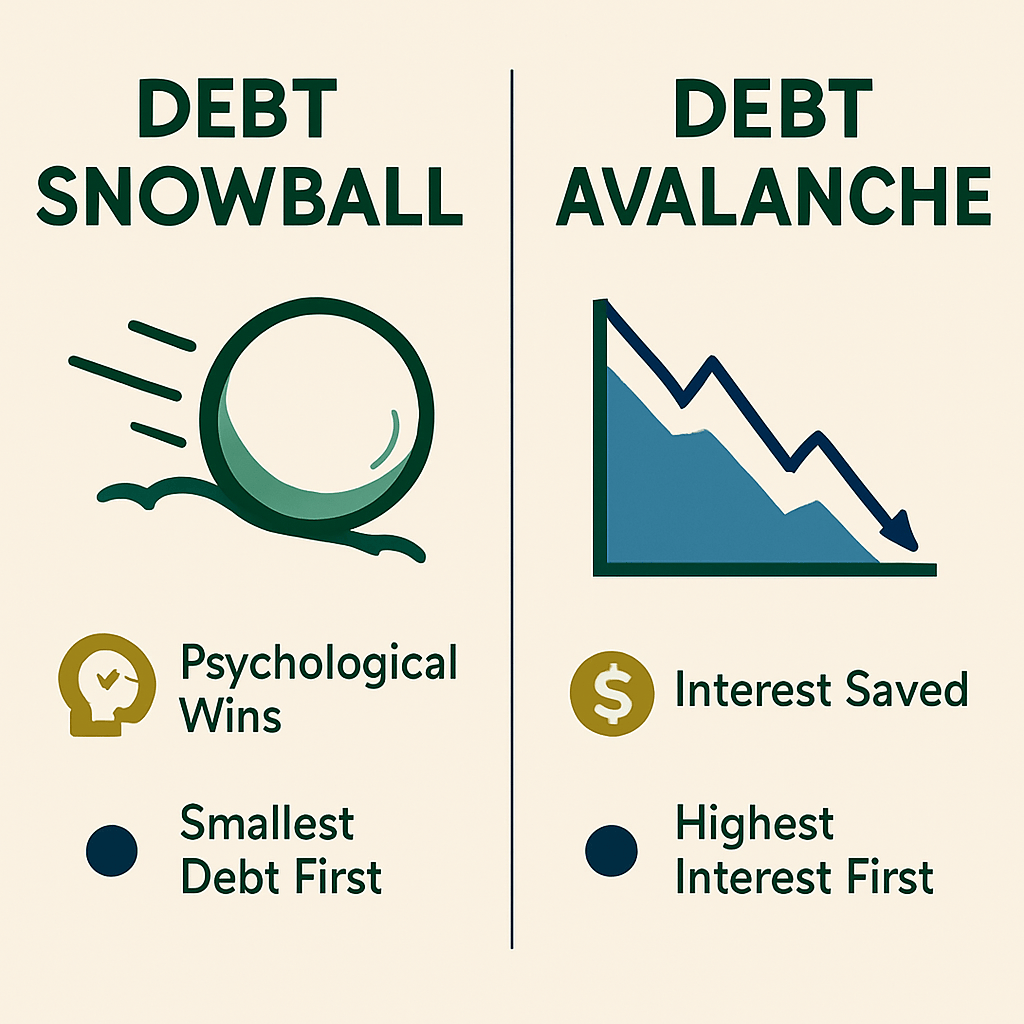
Focus: Psychological Wins & Momentum
The Debt Snowball method is the most popular strategy for a reason: it works with human nature, not against it. It ignores interest rates entirely and focuses on the total balance of each debt.
How to do it:
- Order by size: List your debts from the smallest balance to the largest.
- Cover the basics: Pay the minimums on every single debt except the smallest one on your list.
- Attack: Throw every extra cent you have whether it’s $20 from a side hustle or $100 from skipping takeout at that smallest debt.
- The “Snowball” Effect: Once that first debt is gone, you don’t spend that money. You take the entire amount you were paying on it (the minimum + the extra) and add it to the payment for the next smallest debt.
Why it’s great for beginners:
- The Dopamine Hit: Paying off a $450 medical bill in two months feels amazing. That feeling of “I actually did it” is the fuel you need to tackle the $15,000 monster later.
- Less Overwhelm: Every time you cross a debt off, you have one less bill to worry about. Your life literally gets simpler every time a balance hits zero.
- Behavior Change: Research shows that people who see immediate progress are far more likely to stick to a plan than those who focus purely on the math.
The Verdict: If you’ve started and stopped debt plans before, or if you feel completely overwhelmed by the number of bills you have, the Snowball is your best friend.
Strategy B: The Debt Avalanche Method
Focus: Mathematical Efficiency & Saving Money
If you’re the type of person who hates the idea of giving banks a single extra penny in interest, the Debt Avalanche is for you. This is the “smartest” way to pay off debt on paper because it targets the most expensive debt first.
How to do it:
- Order by interest: List your debts from the highest interest rate to the lowest.
- Cover the basics: Pay minimums on everything except the debt with the highest APR (Annual Percentage Rate).
- The Heavy Hitter: Direct all your extra cash toward that high-interest debt first. This is usually a credit card or a payday loan. If most of your balances are on credit cards, read Credit Card Debt: Your Guide to Pay It Off and Stay Debt-Free for a deeper breakdown.
- The Cascade: When that first debt is dead, move all that money to the next highest interest rate on the list.
Why it makes sense:
- Cheaper: You will pay significantly less in total interest over the life of your debt.
- Faster (Mathematically): Because less interest is “eating” your payments, more of your money goes toward the actual balance, which can shorten your total payoff time.
📊 The Proof is in the Math: A Real-World Example
To see why this choice matters, let’s look at a real scenario. Imagine “Alex” has $20,000 in debt across three accounts and has an extra $500 per month to put toward debt.
- Debt 1: $1,500 Store Card (28% APR)
- Debt 2: $3,500 Medical Bill (0% APR)
- Debt 3: $15,000 Student Loan (6% APR)
The Debt Snowball Results:
Alex pays the Medical Bill first (smallest balance). Even though it has 0% interest, Alex gets that “win” quickly.
- Total Interest Paid: ~$4,800
- Time to Debt Free: 31 Months
- Experience: Alex felt great after 7 months when the first debt was gone.
The Debt Avalanche Results:
Alex pays the Store Card first (highest interest).
- Total Interest Paid: ~$3,150
- Time to Debt Free: 28 Months
- Experience: Alex saved $1,650 and finished 3 months sooner, but didn’t see a “zero balance” for over a year.
Debt Snowball vs. Debt Avalanche: Which is Practical?
| Feature | Debt Snowball | Debt Avalanche |
|---|---|---|
| Primary Goal | Stay motivated via “Quick Wins.” | Save the most money possible. |
| First Target | Smallest Balance (regardless of rate). | Highest Interest Rate (regardless of balance). |
| Estimated Savings | Lower (You pay more interest). | Higher (You save thousands in APR). |
| Payoff Speed | Feels faster initially. | Mathematically faster overall. |
| Best For… | Beginners & “Reluctant” Budgeters. | Analytical Minds & High-Interest Debtors. |
Deep Dive: How to Rank for Topical Authority
If you want to truly master your finances, you need to look beyond just “which one to pick.” Here are the advanced questions most beginners forget to ask.
1. How much “Extra” should I really pay?
There is no magic number, but most financial experts suggest aiming for at least 10–20% of your take-home pay toward debt. If that sounds impossible, start with $50 a month. If you’re not sure what you can realistically afford, start with a Financial Wellness Check-Up: 7 Questions to Ask Yourself Annually The goal is to break the habit of only paying minimums. Minimum payments are designed by banks to keep you in debt for 20+ years.
2. What if I have multiple credit cards at similar rates?
If you have three credit cards all around 24-26%, use a Hybrid Strategy. Target the one with the smallest balance first (Snowball style). Since the interest rates are similar, you won’t lose much money by ignoring the “Avalanche” math, but you’ll get the psychological boost of closing an account.
3. Should I consolidate my debt first?
Debt consolidation (taking out one low-interest loan to pay off several high-interest ones) can be a powerful tool, but it’s a double-edged sword.
- The Pro: You get a lower interest rate and one easy payment.
- The Trap: If you don’t fix your spending habits, you’ll end up with a consolidation loan plus new credit card debt.
- The Rule: Only consolidate if the new interest rate is at least 5% lower than your current average and you have committed to a strict budget.
4. What about “The Scarcity Trap”?
For many beginners, debt isn’t just a math problem; it’s a “scarcity” problem. When you feel like you never have enough, you tend to make impulsive financial decisions. This is why the Snowball is often recommended by psychologists. By seeing a balance hit zero, you move from a “scarcity mindset” (I’m failing) to a “growth mindset” (I’m winning).
💡 Real-Talk Tips for Long-Term Success
- The “Starter” Emergency Fund: Do not—I repeat, do not—start a debt payoff plan with $0 in the bank. Save $1,000 first. Why? Because life happens. If your tire blows out and you don’t have $1,000, you’ll put the repair on a credit card and feel like your whole plan failed.
- The “Why” Behind the Buy: While you’re paying off debt, ask yourself why you got into it. Was it an emergency? Or was it “lifestyle creep”? Identifying the root cause is the only way to ensure the debt doesn’t come back.
- Celebrate the Milestones: When you hit 50% debt-free, have a “budget-friendly” celebration. Buy a nice bottle of wine or have a movie night. You’re doing hard work; acknowledge it.
- Forgive the Slip-ups: You might overspend on a holiday or a birthday. It happens. Don’t use one bad weekend as an excuse to give up on the next three years. Just start again on Monday.
Common Questions (FAQs)
Q: Can I use both methods at once? Actually, yes! This is called the “Blended Method.” You might pay off two tiny debts using the Snowball for the ego boost, then switch to the Avalanche to tackle a high-interest credit card that’s keeping you up at night.
Q: Should I stop contributing to my 401(k) while paying off debt? If your employer offers a match, try to contribute at least enough to get that match. That’s a 100% return on your money—no debt interest rate is high enough to beat that. If there’s no match, it’s often better to pause investing temporarily to crush high-interest debt (20%+).
Q: My debt is so high I can’t even afford the minimums. What now? If you can’t cover the minimums, neither the Snowball nor the Avalanche will work yet. You need to contact your creditors and ask for a “Hardship Program” or look into non-profit credit counseling. There is no shame in asking for help.
Ready to take the first step?
Debt is a heavy weight, but it’s not a life sentence. Whether you choose the psychological power of the Snowball or the ruthless efficiency of the Avalanche, the most important thing is that you stop standing still.
Pick your “Target Debt” today. Look at your bank account, find $20, and send it toward that balance right now.
What’s the first debt you’re going to tackle? Tell us in the comments!
Sources & Further Reading: 1. Investopedia: How the Snowball Method Works 2. Experian: Choosing Between Snowball and Avalanche 3. Harvard Business Review: Research on Why the Snowball Method is Most Effective for Motivation
Keep reading
How Much of Your Salary Should You Save as an Expat?
Most expats have no pension waiting back home. Here's how much of your salary to save, using a simple 3-tier plan you can start this month.
Managing Money in Two Currencies: 7 Ways to Stop Losing to Fees
Earning in one currency and spending in another quietly costs you money. Here's where the fees hide and 7 ways to stop losing to them.
Emergency Fund for Expats: Why 3 Months Isn’t Enough
The classic 3-month rule ignores what happens to your visa when you lose your job. Here's how big an expat emergency fund really needs to be.
[…] particularly those with high interest rates. Consider employing debt reduction strategies like the Snowball or Avalanche methods to tackle debt […]
[…] small adjustments free up money for savings, debt repayment (perhaps using a Debt Snowball vs Avalanche strategy), or building your emergency […]
[…] services. These small adjustments free up money for savings, debt repayment (perhaps using a Debt Snowball vs Avalanche strategy), or building your emergency […]
[…] services. These small adjustments free up money for savings, debt repayment (perhaps using a Debt Snowball vs Avalanche strategy), or building your emergency […]
[…] and projected financial situation. If you’re paying off other debts too, see our guide on Debt Snowball vs. Avalanche methods to choose the right […]
[…] If debt is holding you back, learn how to tackle it faster with our post on Debt Snowball vs. Avalanche Strategies […]
[…] 💳RELATED How to Pay Off Debt Fast: Find the Strategy That Actually Sticks → […]