Disclosure: This post may contain affiliate links. If you buy through them, I earn a small commission at no extra cost to you. I only recommend tools I’d actually use.
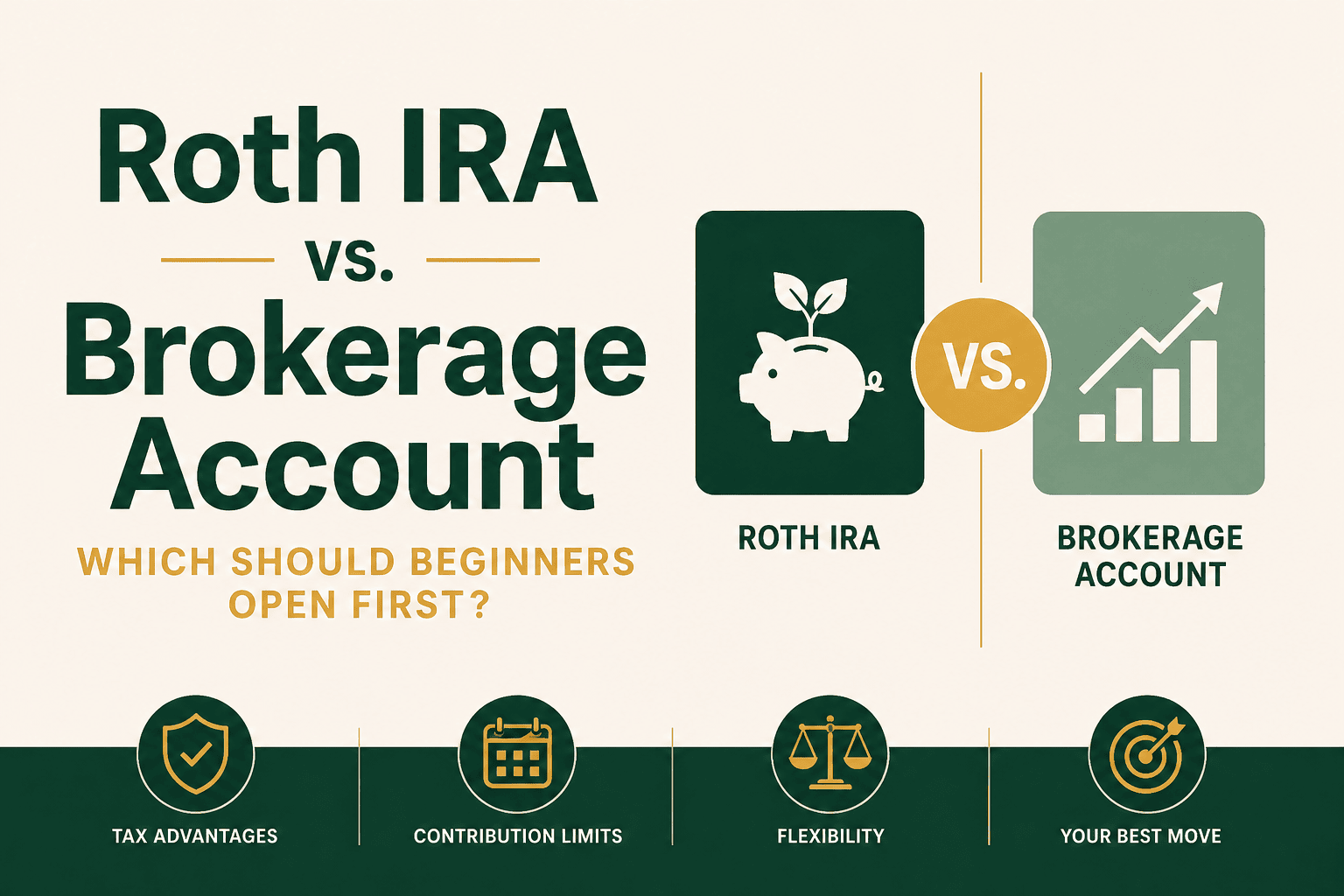
Most beginners get stuck on this question longer than they should. The short answer: open the Roth IRA first. It gives you a tax advantage that a regular brokerage account can never match. But there is a catch, and it is worth knowing before you move any money.
In this guide, you will see exactly how these two accounts differ, which one fits your situation, and when it makes sense to use both. By the end, you will know your next step.
What Each Account Actually Is
Think of these as two different containers for your investments. Both hold the same things: stocks, ETFs, mutual funds, bonds. The difference is in how the IRS treats the money inside them.
A Roth IRA is a retirement account. You put in money you have already paid tax on. Then it grows tax-free. When you retire, you pull it out tax-free too. That is a powerful deal. The trade-off is that the IRS limits how much you can put in each year and who can use it based on income.
A taxable brokerage account has none of those limits. You can deposit as much as you want. You can take the money out whenever you want. But every time you sell an investment for a profit, you owe capital gains tax. Dividends get taxed too. It is flexible, but it costs you more in taxes over time.
If you are just starting your investing journey, check out our full beginner investing guide for the bigger picture first.
Roth IRA vs Brokerage Account: Side-by-Side
| Feature | Roth IRA | Brokerage Account |
|---|---|---|
| Tax on growth | None (tax-free) | Capital gains tax applies |
| Annual contribution limit | $7,500 (2026, under 50) | No limit |
| Income limits | Yes (phases out ~$150k+ single) | None |
| Withdrawal flexibility | Contributions anytime; earnings after 59½ | Anytime, no penalty |
| Best for | Long-term retirement savings | Flexible goals, short-to-mid term |
Contribution limits are set by the IRS and change with inflation. Check IRS.gov for the most current figures.
Which One Should You Open First?
Here is the priority order that most guides skip:
- Get the full 401(k) employer match first. Free money beats everything.
- Max out your Roth IRA next. Tax-free growth is worth more than flexibility.
- Open a brokerage account after that with any money left over.
Why put the Roth second and not first? Because passing up a 401(k) match is leaving part of your salary on the table. A 50% match on $6,000 is $3,000 you never have to earn again.
The Roth beats the brokerage because taxes compound the same way money does. Every dollar you avoid paying in taxes stays invested and grows. Over 30 years, that difference adds up to a serious number. Compound interest works both ways, and taxes are a silent drag on your returns.
The one exception: if you earn above the Roth IRA income limit (roughly $150,000 as a single filer in 2026), you may not be able to contribute directly. In that case, a brokerage account is your default. You can also explore a backdoor Roth, but that is a topic for once you have the basics down.
💡 Tool Recommendation
Fidelity lets you open both a Roth IRA and a brokerage account in the same place, with zero account minimums and zero trading commissions. If you want one platform that handles both accounts without the fees, it is the one I would actually start with as a beginner.
Also worth knowing: Roth IRA is not the only IRA option. If you want to compare Roth vs Traditional, here is our full Roth vs Traditional IRA breakdown.
When a Brokerage Account Makes More Sense
There are real situations where you should skip the Roth first and go straight to a brokerage account.
You need the money in less than five years. The Roth has a five-year rule on earnings. Pull them too early and you pay taxes plus a 10% penalty. A brokerage account has none of that. If you are saving for a house down payment or a career break, a brokerage account keeps your options open.
You earn above the Roth IRA income limits. If your income disqualifies you, a brokerage account is not a consolation prize. It is just your best tax-advantaged option that is still on the table after maxing your 401(k).
You have already maxed your Roth. Once you hit the $7,500 cap for the year, the brokerage account is where your next dollar goes.
Want to know how to pick what you actually invest in once you open one of these accounts? Our ETF vs mutual fund vs robo-advisor guide walks you through that.
Your Beginner Account Checklist
✅ Roth IRA vs Brokerage Account Checklist
-
☐
Confirm you have earned income this year (required to contribute to a Roth IRA) -
☐
Check your income against the Roth IRA limit at IRS.gov for the current year -
☐
If your employer offers a 401(k) match, contribute enough to capture the full match first -
☐
Open a Roth IRA and set up automatic monthly contributions, even if it is $25 -
☐
Choose your first investment inside the Roth (a broad index ETF is a solid start) -
☐
Open a brokerage account once you have maxed your Roth or have a short-term goal -
☐
Track contributions so you do not accidentally go over the annual Roth IRA limit
Common Mistakes Beginners Make
“I’ll just use a brokerage account because it’s simpler.” It feels simpler until you see your tax bill after a good year. The Roth IRA takes 15 extra minutes to set up and saves you decades of tax drag. Do it right the first time.
“I need the money to be accessible, so the Roth won’t work.” You can pull out your Roth contributions, not the earnings, at any time with no penalty. You do not lose access to the money you put in. Most beginners do not know this.
“I’ll wait until I earn more to invest.” The Roth IRA annual limit does not roll over. Every year you skip is a year of tax-free compound growth you can never get back. Start with $50 a month. The habit matters more than the amount.
Frequently Asked Questions
What is the difference between a Roth IRA and a brokerage account?
A Roth IRA is a tax-advantaged retirement account where your money grows tax-free and qualified withdrawals in retirement are also tax-free. A brokerage account is a regular taxable investment account with no contribution limits, no income restrictions, and no withdrawal penalties, but you pay capital gains tax on profits each year.
Should I open a Roth IRA or brokerage account first?
Open the Roth IRA first after capturing any 401(k) employer match. The tax-free growth in a Roth IRA is a long-term advantage a brokerage account can’t replicate. Only move to a brokerage account after maxing your Roth, or if you earn above the Roth income limits.
Can I have both a Roth IRA and a brokerage account?
Yes. There is no rule against holding both. Most financial experts recommend using both once you can afford to. Max the Roth first for the tax advantage, then invest additional money in a brokerage account for flexibility and goals with shorter time horizons.
What are the Roth IRA income limits for 2026?
For 2026, the ability to contribute to a Roth IRA phases out for single filers starting around $150,000. Single filers earning above $168,000 generally cannot contribute directly. Married couples filing jointly phase out at higher thresholds. Always verify the latest limits at IRS.gov since these figures adjust for inflation annually.
What happens if I withdraw from a Roth IRA early?
You can withdraw your contributions, the money you put in, at any time without tax or penalty. But if you withdraw the earnings before age 59½ and before the account has been open for five years, you will owe income tax plus a 10% penalty on the earnings portion.
📚 Keep Reading
The Bottom Line
You do not need to pick one account forever. You need to pick the right one first. For most beginners, that is the Roth IRA. Start there, let the tax-free growth compound over time, and open a brokerage account once you have room.
The best move you can make today is to open the account and put anything in it. Twenty-five dollars. Fifty. The habit of investing is worth more than the perfect strategy you never start.
What is holding you back from opening your first investment account? Drop it in the comments, and I will try to help.
Want More Tips Like This?
Join our weekly newsletter. No spam — just simple money moves that work.
Leave a Reply