I work in real estate operations here in Abu Dhabi, and for a long time, every investing guide I read assumed I had a Social Security number and a Vanguard account. None of it applied to me. That mismatch is exactly why non-US investors stay on the sidelines far longer than they should.
UCITS ETFs explained simply: a UCITS ETF is an exchange-traded fund registered under European Union rules that any non-US resident, including UAE-based expats, can legally buy through brokers like Interactive Brokers or eToro, without US estate tax exposure or the account restrictions that come with US-domiciled funds. That single distinction is the reason most “beginner investing” advice on the internet does not apply to you.
In this guide:
- The Real Reason Non-US Investors Get Stuck
- The Reframe: You Are Not Missing Out, You Are Reading the Wrong Guide
- What a UCITS ETF Actually Is
- UCITS ETF vs US ETF: What Actually Changes
- Popular UCITS ETFs Non-US Investors Actually Use
- How to Actually Buy a UCITS ETF From the UAE
- FAQ: UCITS ETFs Explained
The Real Reason Non-US Investors Get Stuck
Most people in your position do not fail to invest because they are lazy. They fail because every guide, every YouTube video, and every finance influencer assumes a US audience.
They tell you to open a Vanguard account. They tell you to buy VOO. Nobody mentions that Vanguard’s US retail platform will not open an account for a UAE resident in the first place.
So you close the tab. You tell yourself you will figure it out later. Later turns into a year, then two, and the money that should have been compounding just sits there instead.
The Reframe: You Are Not Missing Out, You Are Reading the Wrong Guide
Here is the uncomfortable part. The problem was never that investing is too complicated for you. The problem is that you were solving the wrong version of the problem.
You do not need a US brokerage account. You do not need a Social Security number. You need a UCITS ETF, and once you understand what that actually is, the rest of this becomes almost boring in a good way. Boring is what you want from your investments.
What a UCITS ETF Actually Is
UCITS stands for Undertakings for Collective Investment in Transferable Securities. It is an EU regulatory framework, and most UCITS ETFs are domiciled in Ireland or Luxembourg for tax reasons.
That is UCITS ETFs explained at the regulatory level, before you even look at a single ticker.
In plain terms, it is a fund built to be sold across borders, to investors who are not American. That single design choice changes almost everything about how it treats your money.
Every time you see a fund with “UCITS” written on it, or a ticker on the London Stock Exchange, Xetra, or Euronext instead of the NYSE, you are looking at a UCITS ETF. Same idea as a US ETF. Different plumbing underneath.
Why does the domicile of an ETF matter?
The domicile decides which country’s tax treaties apply to the dividends the fund receives, and whether you, as the investor, fall under US estate tax rules. An Ireland-domiciled UCITS ETF holding US stocks pays a reduced 15% withholding tax on US dividends under the Ireland-US treaty. A US-domiciled ETF sold directly to a non-US resident carries no such protection, and exposes you to US estate tax exposure above a $60,000 threshold.
UCITS ETF vs US ETF: What Actually Changes
This is where UCITS ETFs explained on paper actually starts to show up in your account.
This is the part most guides skip entirely, so let’s make it concrete.
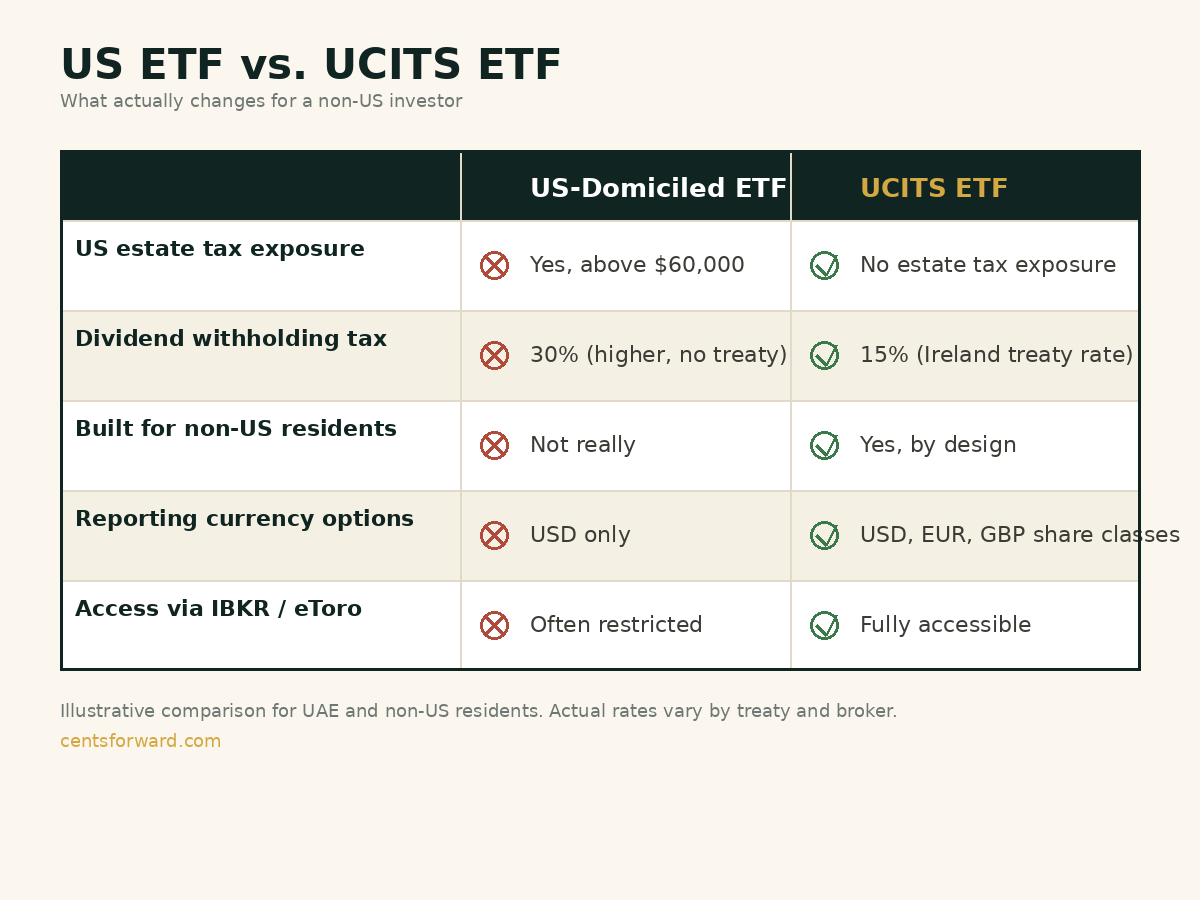
A few things stand out once you see it laid out like this.
The estate tax point is the one nobody warns you about. If you hold US-domiciled ETFs directly as a non-US resident and something happens to you, your estate can owe US estate tax on the portion of your US assets above $60,000. According to the IRS guidance on nonresident estate tax, this applies regardless of where you live, and it is a real, published rule, not a scare tactic.
These funds sidestep that entirely because of how they are structured under EU fund law, which you can read more about directly from the European Commission’s overview of UCITS regulation.
Popular UCITS ETFs Non-US Investors Actually Use
With UCITS ETFs explained, the natural next question is which ones to actually hold.
You do not need dozens of funds. Most people building a straightforward portfolio from the UAE end up with two or three of these.
- A global equity UCITS ETF that tracks the total world market, giving you thousands of companies across every major economy in one purchase.
- A US-focused fund if you want heavier exposure to the S&P 500 specifically, without holding the US-domiciled version directly.
- An emerging markets fund if you want exposure beyond developed economies, which many global funds already include at a smaller weighting.
Look for “Acc” in the fund name if you want dividends automatically reinvested with no manual work on your end, or “Dist” if you would rather receive the dividend as cash. This one naming detail trips up more beginners than almost anything else on this list.
What is the best UCITS ETF for beginners?
There is no single “best” one, but for most people starting out, a broad global accumulating fund is the simplest starting point. It gives you diversification across thousands of stocks in a single trade, with dividends reinvested automatically, so you are not managing multiple funds before you understand what any of them do.
How to Actually Buy a UCITS ETF From the UAE
Once UCITS ETFs explained stop being theory, opening the account is the easy part.
This is the step that stops most people, so let’s remove the mystery.
You need a broker that both accepts UAE residents and gives you access to European exchanges. Interactive Brokers is the one most serious non-US investors end up using, since it gives you direct access to Ireland-domiciled funds on the London Stock Exchange and other European venues. If you want to open that kind of account, open an account with Interactive Brokers and search the ticker directly once you are in.
eToro is the other realistic option for UAE residents, particularly if you want a simpler interface while you are still learning. You can start with eToro and search for the UCITS version of the fund you want, which will usually show a different ticker than the US version of the same fund family.
Before you open either account, our beginner investing checklist walks you through the groundwork you want in place first, things like your emergency fund and your debt situation, so the broker account is not the first domino.
Where This Leaves You
I have spent the last stretch of time building income outside my day job in real estate, and figuring out where to actually invest that money is the unglamorous part nobody talks about. UCITS ETFs were the first time investing research written for someone outside the US actually matched my situation, instead of needing a workaround.
You were never behind. You were just reading advice written for a different investor, in a different country, with a different tax system.
Once you know to search for the UCITS version of a fund instead of the US version, this stops being confusing and starts being routine. That is UCITS ETFs explained the way it should have been from the start: built for you, not despite you.
If you have not built your financial foundation yet, work through our beginner investing checklist before you open any brokerage account. And if you are also thinking about income beyond your salary while you build this portfolio, our passive income guide for beginners covers realistic ways to do that from exactly where you are.
FAQ: UCITS ETFs Explained
Are UCITS ETFs safe for non-US investors?
Yes. They are regulated under EU law, which includes strict rules on diversification, custody, and investor protection. They are widely used by non-US investors specifically because they were built for that purpose from the start.
Can I buy UCITS ETFs from the UAE?
Yes. Brokers that accept UAE residents, including Interactive Brokers and eToro, give you direct access to these funds listed on European exchanges. You do not need a US address or a US brokerage account.
Do UCITS ETFs pay dividends?
Yes, depending on the share class. An “Acc” (accumulating) fund reinvests dividends automatically inside the fund. A “Dist” (distributing) UCITS ETF pays dividends out to you as cash.
Are UCITS ETFs more expensive than US ETFs?
Slightly, in most cases. Expense ratios on these funds tend to run a little higher than their US-domiciled equivalents, but the estate tax and withholding tax savings usually outweigh that difference for a non-US investor.
What does UCITS ETFs explained actually mean in one sentence?
UCITS ETFs explained simply: they are EU-regulated funds built for non-US investors, giving you the same index exposure as US ETFs without the estate tax exposure or broker restrictions.
This post contains affiliate links. If you open an account through one of them, CentsForward may earn a commission at no extra cost to you. I only recommend platforms I have researched or used directly.
