Managing money in two currencies feels manageable until the transfer lands and the number is smaller than you expected. No warning. No breakdown. Just a few percent gone, somewhere between your account and theirs.
Managing money in two currencies without losing to fees really comes down to three habits: check the real exchange rate before you convert anything, use a low-margin provider instead of your bank, and convert less often than you think you need to. Get those three right and your currency costs usually drop from the 2 to 5 percent banks quietly build into their rates down to under 1 percent.
The Problem Isn’t the Fee You See
The visible fee is rarely the expensive part. A $30 wire charge is annoying, sure, but at least it’s honest. It’s sitting right there on the receipt.
The real cost is baked into the exchange rate itself, and nobody points it out. You transfer money, glance at what landed, and assume the rate was fair because there’s no separate “fee” line anywhere. That’s exactly the assumption banks are counting on.
The Reframe: You’re Not Paying a Fee, You’re Paying a Markup
Here’s the part that stings a little. Most people juggling two currencies think they’ve already dealt with the cost, because they picked a bank that advertises “no transfer fee.” A 0-fee transfer isn’t actually free, though. The bank just moved its profit into the exchange rate you were quoted, where it’s harder to spot and a lot easier to accept without question.
This is the mid-market rate problem. The mid-market rate is the real exchange rate, the one you’d see if you typed “USD to EUR” into Google right now, the midpoint between what currency traders are willing to buy and sell at. Banks almost never give you that rate. They quote their own version instead, usually 2 to 5 percent worse, and call the gap a margin rather than a fee.
In this guide:
- The Problem Isn’t the Fee You See
- The Reframe: You’re Not Paying a Fee, You’re Paying a Markup
- Step 1: Stop Letting Your Bank Manage Your Money in Two Currencies
- Step 2: Pick a Base Currency and Stop Guessing
- Step 3: Time Your Transfers Instead of Reacting to Them
- Step 4: Use a Multi-Currency Account for Anything Recurring
- Step 5: Track the Real Cost, Not the Advertised One
- Frequently Asked Questions
Step 1: Stop Letting Your Bank Manage Your Money in Two Currencies
This is the single biggest lever you have. Every time your bank converts currency for you automatically, whether that’s an incoming salary, an outgoing transfer, or a card swipe abroad, it quietly applies its own marked-up rate. You never see the markup, so you never think to question it.
The fix is simple to describe and easy to keep putting off: route your conversions through a provider that shows you the mid-market exchange rate upfront and charges a small, visible fee instead of hiding it in the rate. Most people who end up managing money across two currencies land on Wise for this exact reason, because it publishes its margin instead of burying it in the fine print. Open a free Wise account and you can see your real rate before you commit to anything, no bank branch required.
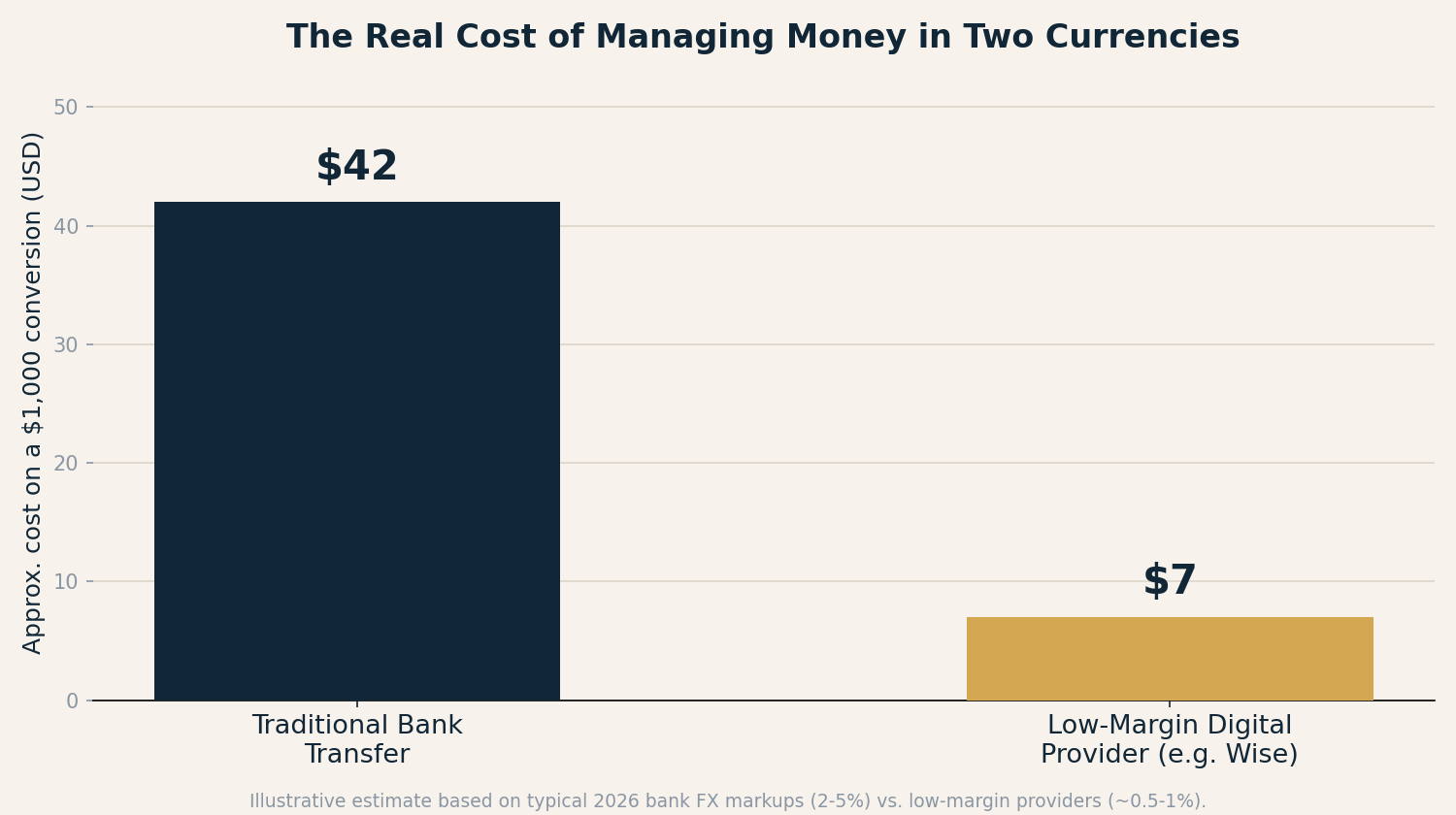
On a $1,000 conversion, that difference alone is often the gap between losing $40 and losing $7.
Step 2: Pick a Base Currency and Stop Guessing
If you’re paid in one currency and spend in another, decide which one is actually “yours.” For most people budgeting on an expat salary, that’s USD, since it’s the currency your savings and investments will probably live in long term. From there, convert into your spending currency on purpose instead of flipping back and forth every time a payment lands.
This is where psychology gets in the way more than math does. Bouncing between two currencies keeps your brain doing conversion math instead of actually deciding anything. “200” means something different depending on which currency it’s in that week, so you lose track of what things really cost. Anchoring to one base currency clears that fog, and every other money decision gets easier once it’s gone.
Step 3: Time Your Transfers Instead of Reacting to Them
Exchange rates move throughout the day and across the week, sometimes more than people expect. Converting the moment money lands, out of habit or urgency, means accepting whatever rate happens to be live at that second, good or bad.
A better pattern: batch it. Convert once or twice a month on a set schedule instead of every time a bill shows up. If you’re building an emergency fund as an expat, this also protects that fund from getting nibbled away by a dozen small, badly timed conversions instead of a few deliberate ones.
Step 4: Use a Multi-Currency Account for Anything Recurring
If you’re regularly moving money between two currencies, whether that’s a salary, rental income, or earning income in USD from anywhere as a freelancer, a multi-currency account changes the math. It lets you hold both currencies at once and convert when the rate actually favors you, instead of being forced to convert the moment the money arrives.
That matters even more if you’re doing freelance work that pays in dollars while living somewhere that doesn’t use dollars. A multi-currency account means a client payment doesn’t get chewed up by an automatic, same-day conversion at whatever rate your bank feels like offering that morning.
Step 5: Track the Real Cost, Not the Advertised One
Before any transfer, do the two-minute math instead of trusting the label. Look up the mid-market rate, compare it to what your provider is actually offering you, and multiply the gap by your transfer amount. That’s your real cost, not whatever fee is printed on the confirmation screen.
Providers rarely advertise this gap, because it’s called the foreign exchange spread, the difference between the buy and sell price of a currency pair, and keeping it vague is completely legal. Checking it yourself, even roughly, is the one habit that keeps managing money in two currencies from running on autopilot.
Frequently Asked Questions About Managing Money in Two Currencies
What’s the cheapest way to convert two currencies?
Use a low-margin digital provider that shows the mid-market rate upfront and charges a small, visible fee, rather than a traditional bank that hides its markup inside the exchange rate. On average this cuts the total cost of managing money in two currencies from roughly 2 to 5 percent down to under 1 percent per conversion.
Should I convert everything to one currency or keep both?
If you regularly earn or spend in a second currency, keep both and hold them in a multi-currency account. Converting everything immediately, out of habit, usually costs more in repeated fees than holding a working balance in each currency and converting deliberately when it makes sense.
Do banks or apps like Wise offer better exchange rates?
Apps built specifically for currency transfers, like Wise, typically publish rates much closer to the true mid-market rate and disclose their fee separately. Traditional banks usually build a bigger, undisclosed markup directly into the rate they quote you, which is most of what makes managing money in two currencies through a bank so expensive.
One Habit, Not a Full Overhaul
You don’t need to rebuild your entire financial setup this week. Pick one step, probably routing your next transfer through a provider that actually shows its rate, and start there. The rest tends to fall into place once that first habit sticks.
Ready to stop guessing at your rates every month? Subscribe to the CentsForward newsletter for one honest money move every week.
