Every broker comparison I found when I started investing was built for Americans. Fidelity. Vanguard. Schwab. Robinhood. Great platforms, probably. But every single one of them turned me away the moment I entered my UAE address.
It took me longer than it should have to find the best brokers for non-US investors — platforms that actually work for people like me, who want to invest in global markets without jumping through hoops or paying a fortune in fees. I have since opened accounts with three different brokers, made real trades, moved real money through all of them, and learned what matters and what does not.
This is what I wish someone had written for me three years ago.
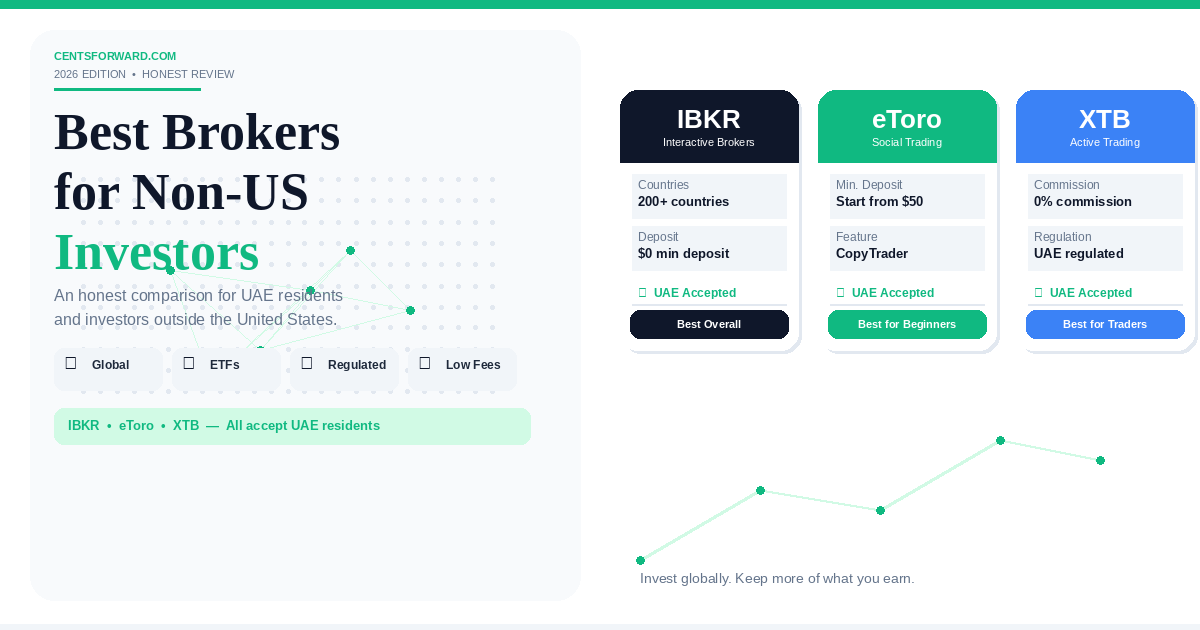
The best brokers for non-US investors in 2026 are Interactive Brokers (IBKR), eToro, and XTB. All three accept UAE residents, offer access to US and global markets, and have no capital gains tax complications for UAE-based accounts. They serve different types of investors, so the right one depends on what you are trying to do.
In this guide:
- Why Most Broker Lists Fail Non-US Investors
- What to Actually Look for in a Broker
- Interactive Brokers (IBKR): Best Overall
- eToro: Best for Beginners
- XTB: Best for Active Traders
- Side-by-Side Comparison
- Which Broker Should You Open?
- My Personal Experience
- FAQ
Why Most Broker Lists Fail Non-US Investors
Ninety percent of “best broker” articles online were written by Americans, for Americans. The platforms they recommend — Fidelity, Charles Schwab, Robinhood, Betterment — require a US Social Security number, a US address, or a US bank account to open. If you live in the UAE, South Africa, India, or most of Southeast Asia, those platforms will reject your application.
There are roughly 281 million people living outside their country of birth. Most of them earn decent money. Most of them want to invest. And most of them get pointed toward platforms they cannot actually use. The best brokers for non-US investors are simply not covered by mainstream finance media, because that media does not write for people like us.
The platforms below all accept non-US residents, hold real regulatory licenses, and give you access to real markets. Not a curated list of CFDs or some offshore workaround. Actual stocks, actual ETFs, actual ownership — from wherever you are in the world.
What to Actually Look for in a Broker
Before diving into the platforms, it helps to agree on what actually matters. A lot of broker comparisons lead with features most people never use. Here is what affects your returns and your experience day to day when you are not a US resident.
Does it accept your country of residence?
This is the filter that eliminates most of the market immediately. Check this before anything else. Regulations change, and a broker that accepted your country last year may restrict new accounts today. Always verify on the broker’s website directly during account opening, not just through a third-party review.
What are the actual fees?
Commission-free trading is standard now, but “free” trading is almost never completely free. Currency conversion fees (typically 0.5% to 1.5%), withdrawal fees, and inactivity fees are where brokers make their money on passive investors. These costs compound over time in ways that stock commissions used to.
What can you actually invest in?
Some platforms that accept international clients still restrict your access to a limited product menu. For most investors building long-term wealth, you want access to US-listed ETFs, global stocks, and ideally fractional shares. Confirm the platform allows this before you fund an account.
Who regulates it?
Regulation is not just paperwork. It determines whether your funds are held in a segregated account, whether there is a compensation scheme if the broker fails, and whether you have any legal recourse if something goes wrong. Look for Tier-1 or Tier-2 regulators: SEC, FINRA, FCA, CySEC, DFSA (UAE), or ASIC as a minimum standard.
If you are still building your financial foundation before opening a brokerage account, read our 10-step beginner investing checklist first. It covers exactly what to do before you put a single dollar into any investment platform.
Interactive Brokers (IBKR): Best Overall for Non-US Investors
IBKR is the platform I use for the bulk of my own portfolio. It is not the prettiest app, and onboarding takes a few days longer than a fintech product. But for access, pricing, and reliability, it is the strongest choice among the best brokers for non-US investors bar none.
What makes IBKR stand out
Interactive Brokers accepts clients from over 200 countries and territories. That alone separates it from most of the market. For UAE residents, account registration is fully online and approval typically takes two to four business days. You get access to stocks, ETFs, bonds, options, futures, and forex across global exchanges — not a curated subset.
The IBKR Lite tier offers $0 commission on US stocks and ETFs, available to many international clients. IBKR Pro gives you very low per-share rates if you trade frequently and want better execution. Either way, the fee structure is among the lowest available to retail investors outside the US.
IBKR also pays interest on uninvested cash balances. For UAE residents with no access to high-yield savings accounts, this is a meaningful extra return on money sitting idle between investments.
The honest downsides
IBKR’s platform is built for people who take investing seriously. The interface is dense. If you are opening your very first brokerage account, the number of configuration options can feel like too much on day one. It clicks after two to three weeks, but that first week is genuinely a lot.
Customer support is competent but not instant. You are dealing with a global institution, not a startup with a live chat team. Expect email responses, not immediate answers.
Best for: Long-term investors and active traders who want the lowest fees, genuine global access, and a platform they will never outgrow.
You can open an Interactive Brokers account here. This is my personal referral link — both of us receive a benefit when you fund your account.
eToro: Best for Beginners Among Non-US Brokers
eToro was the first broker I ever used. There is a clear reason it is popular among people just starting out — the platform is built to make investing feel approachable, not intimidating. For non-US investors who want to get started without a steep learning curve, eToro sits near the top of the list.
What makes eToro stand out
eToro accepts UAE residents and most non-US countries with no friction. You can open an account and begin investing with as little as $50. Fractional shares are available, which means you can buy a piece of a broad ETF or a major company without needing thousands of dollars upfront.
The feature that genuinely sets eToro apart is CopyTrader. It lets you automatically mirror the real trades of experienced investors on the platform. You pick someone whose strategy aligns with your goals, allocate an amount, and your account replicates their moves in real time. For an investor who does not have time to research individual stocks, this is a real option rather than a gimmick.
Zero commission on real stock and ETF purchases (as opposed to CFDs) keeps the cost of getting started very low.
The honest downsides
eToro charges a flat $5 withdrawal fee every time you move money out. For smaller accounts, this adds up quickly. There is also a currency conversion cost on deposits, since all accounts are held in USD. If you deposit in AED or euros, you pay to convert.
The platform prominently features CFD trading alongside real share purchases, and for beginners the distinction is not always obvious. When building a long-term portfolio, confirm you are buying the real underlying asset rather than a derivative position.
Best for: Beginners who want a clean interface, low minimums, and the option to follow experienced investors automatically.
You can open an eToro account here. eToro is regulated by the FCA, CySEC, and ASIC, and accepts UAE residents.
eToro is a multi-asset investment platform. The value of your investments may go up or down. Your capital is at risk.
XTB: Best for Active Traders Among Non-US Brokers
XTB does not get as much attention outside Europe, but it has built a serious product for international investors. It now holds both a DFSA license and a CMA (UAE mainland) license, making it one of the only brokers on this list with a direct local regulatory presence in the UAE.
What makes XTB stand out
XTB offers commission-free trading on stocks and ETFs up to 100,000 euros in monthly volume. For most retail investors, that is effectively free stock trading with no practical cap. You get access to over 6,000 real shares across 16 global exchanges, plus around 300 ETFs — a solid selection for non-US investors building a diversified portfolio.
The xStation 5 platform is one of the better-designed trading interfaces available to retail investors. The stock scanner filters by dividend yield, P/E ratio, EPS, and other fundamentals — more analytical depth than most consumer-facing apps offer. A free demo account lets you get familiar before you commit any real capital.
XTB is publicly listed on the Warsaw Stock Exchange. That means it publishes audited financial statements, which adds a layer of transparency that private broker competitors do not have.
The honest downsides
The 0.5% currency conversion fee is above average. If you are regularly buying USD-denominated assets from a non-USD account, this cost compounds. There is also an inactivity fee of 10 euros per month after one year with no trades and no deposits in the prior 90 days — worth knowing if you are a slow, deliberate investor.
Best for: Active investors and swing traders who want a professional platform, UAE-local regulation, and zero commission up to a high monthly threshold.
You can open an XTB account here. XTB holds DFSA and CMA licenses in the UAE, plus FCA and CySEC licenses internationally.
72-76% of retail investor accounts lose money when trading CFDs with XTB. Investing in real stocks and ETFs does not carry the same leverage risk.
Side-by-Side Comparison of the Best Brokers for Non-US Investors
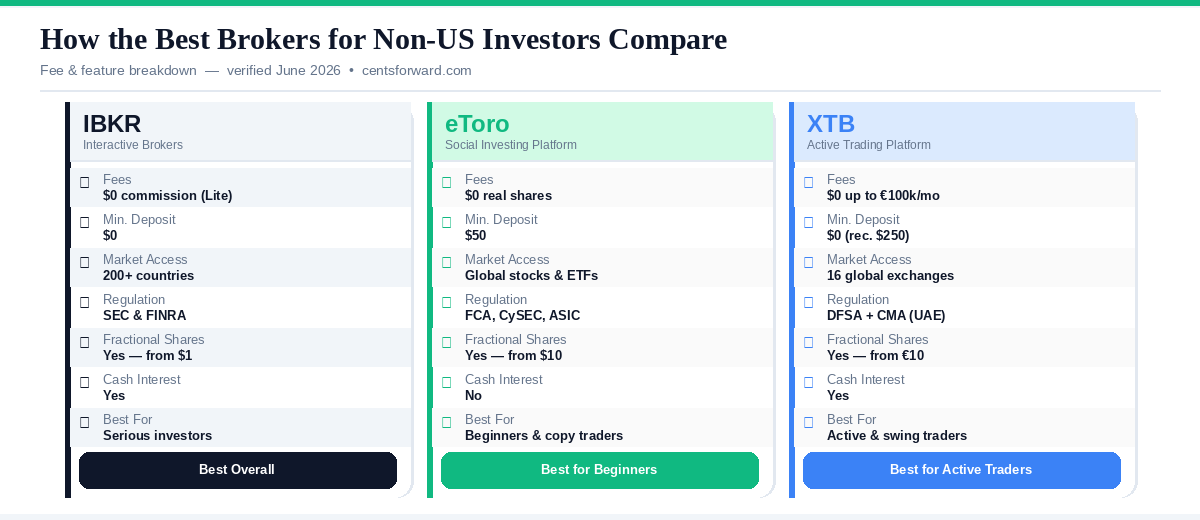
| Feature | IBKR | eToro | XTB |
|---|---|---|---|
| Accepts UAE residents | Yes | Yes | Yes (DFSA + CMA) |
| Minimum deposit | $0 | $50 | $0 (recommends $250) |
| Stock/ETF commissions | $0 (Lite) / Low (Pro) | $0 on real shares | $0 up to €100k/month |
| Fractional shares | Yes | Yes (from $10) | Yes (from €10) |
| Currency conversion fee | Very low | ~50 pips on deposit | 0.5% per transaction |
| Withdrawal fee | $0 (first/month) | $5 flat | $0 |
| Interest on cash | Yes | No | Yes |
| Inactivity fee | None (IBKR Lite) | $10/month after 12 months | €10/month after 12 months |
| UAE regulation | SEC, FINRA | FCA, CySEC, ASIC | DFSA, CMA (UAE) |
| Best for | Serious investors | Beginners | Active traders |
Which of the Best Brokers for Non-US Investors Should You Open?
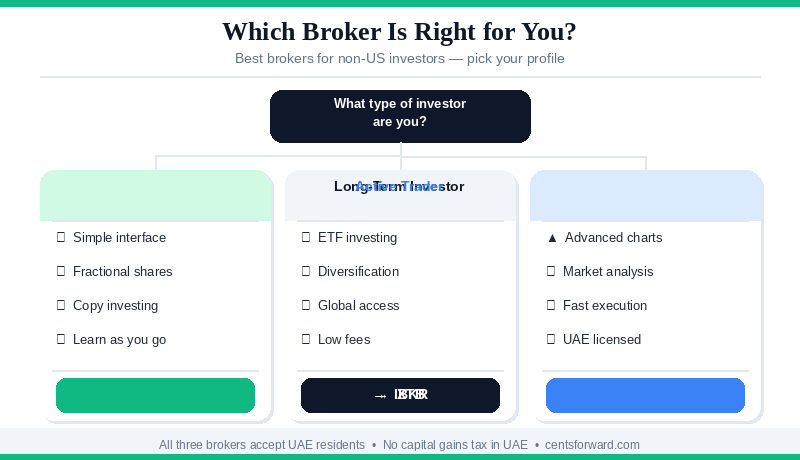
Most comparison posts dodge this question. Here is a direct answer.
If you are just getting started: Open eToro. The $50 minimum is genuinely low, the interface requires no learning curve, and CopyTrader gives you a way to participate in the market while your own knowledge develops. Once you understand what you are doing, move to IBKR for better long-term economics.
If you are a few months in and taking this seriously: Open IBKR. The platform rewards you as your portfolio grows. Lower fees, more instruments, better execution, and interest on your cash. This is where I keep the majority of my own capital. It is built to last.
If you trade actively and want UAE-local regulation: XTB belongs on your list alongside IBKR. The xStation interface is purpose-built for active investors, the local UAE licensing matters from a regulatory comfort perspective, and commission-free trading up to 100,000 euros per month is genuinely competitive for anyone building positions regularly.
You do not have to choose just one. I use IBKR as my primary account and keep a smaller eToro account for positions I want to test and for the copy feature. Having two accounts is not over-complicating things — it is using the right tool for each job.
Once your account is open and funded, the next question is what to actually buy. Our guide on building passive income as a beginner covers how to structure a simple ETF-based portfolio that generates returns without you staring at charts all day.
My Personal Take After Using All Three
When I first opened IBKR I nearly quit on day three. Not because something went wrong, just because the platform genuinely looks like it was designed for someone who already has a Bloomberg terminal at home. I sat there staring at account types — individual, joint, trust, IRA — none of which made sense to me at the time living in Abu Dhabi. I picked one, got it wrong, had to email support, waited two days for a reply. Not a great start.
Meanwhile my eToro account was already funded and I had bought a few shares of a Vanguard S&P 500 ETF within about fifteen minutes of signing up. That contrast stuck with me. eToro felt like it was built for a person. IBKR felt like it was built for an institution that occasionally lets regular people in.
But here’s the thing. About six weeks in, I bought a position on IBKR during a pullback in early 2023 — nothing complicated, just adding to an ETF I already held. The total cost including currency conversion came to something like $2.40 in fees on a $1,800 trade. I checked the same trade on eToro out of curiosity. Between the spread and the conversion, it would have cost me closer to $22. On one trade. That gap is what changed my mind permanently. I still use eToro for smaller positions and testing ideas, but anything I actually want to hold goes through IBKR.
Start with eToro if you are new. Move to IBKR when the fees start to bother you. That is honestly the most natural path and the one I took without planning it that way.
FAQ: Best Brokers for Non-US Investors in 2026
What is the best broker for non-US investors who want to buy US ETFs?
Interactive Brokers (IBKR) is the strongest overall option among the best brokers for non-US investors who want US ETF access. It accepts clients from over 200 countries, gives you access to the full range of US-listed ETFs, and offers very low fees at scale. eToro is the better starting point for beginners who want a simpler first experience.
Can UAE residents open a brokerage account to invest in US stocks?
Yes, UAE residents can open accounts with IBKR, eToro, and XTB — all three of which provide direct access to US-listed stocks and ETFs. UAE residents also pay zero capital gains tax, which makes a standard brokerage account more powerful here than in most other countries. For more detail, read our beginner investing checklist for international investors.
Is there a minimum deposit to use the best brokers for non-US investors?
No meaningful minimum at any of the three platforms covered here. IBKR has no deposit minimum. XTB recommends $250 but does not enforce it. eToro requires $50 to begin investing. You can realistically start with $100 and build from there.
Are IBKR, eToro, and XTB safe for international investors?
All three hold licenses from credible regulatory authorities. IBKR is regulated by the SEC and FINRA in the US. eToro holds FCA, CySEC, and ASIC licenses. XTB holds FCA and CySEC licenses plus a DFSA license and CMA license specifically for the UAE. Client funds at all three are held in segregated accounts, separate from the broker’s own operational funds.
What taxes do UAE residents pay when investing through these brokers?
UAE residents currently pay no personal income tax and no capital gains tax. US-listed stocks do carry a 30% withholding tax on dividends paid by US corporations, deducted at source regardless of which broker you use. For long-term growth-focused investors building through ETFs, the dividend withholding has a manageable impact on overall portfolio returns.
The best broker for non-US investors is the one you actually open and fund. If you have been delaying this decision because you did not know which platform to trust, you now have a clear picture of the three that actually work. Pick one. Open the account this week. Start with whatever you can afford. An account sitting at zero compounds nothing.
Ready to take the next step? Our 10-step beginner investing checklist walks you through exactly what to do after your account is approved — from choosing your first ETF to setting up automatic contributions.
