
Disclosure: some links in this post are referral links. If you sign up through them, CentsForward may earn a commission at no extra cost to you. Read the full affiliate disclosure.
Your salary has a ceiling. Your expenses do not. And if you earn in a local currency, inflation or a sudden devaluation can quietly shrink what you already have.
The good news: you do not need to be American, live in the US or have a US bank account to earn in USD. Millions of people in the Gulf, Africa, Asia and Latin America already get paid in dollars online. This guide shows you 7 proven ways to earn in USD from anywhere, how to get paid in USD without a US bank account, and what to do with your dollars once they arrive.
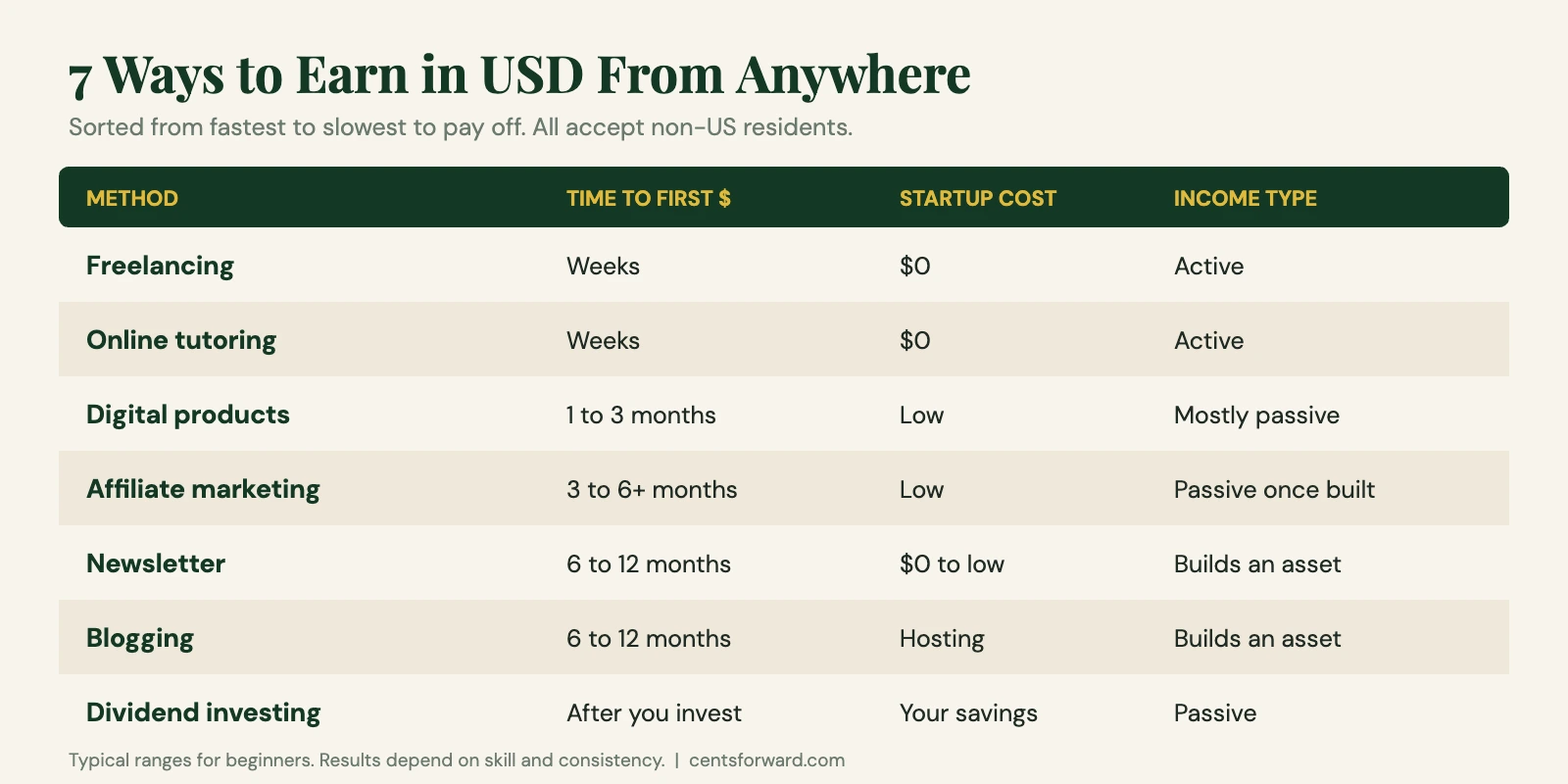
The short answer: the most reliable ways to earn in USD from anywhere are freelancing, affiliate marketing, selling digital products, blogging, online tutoring, building a newsletter and dividend investing. All of them pay in US dollars and accept non-US residents. You can get paid in USD through Wise, Payoneer, PayPal or a USD account at your local bank, with no US bank account needed.
In this guide:
- Why Earn in USD?
- 1. Freelancing
- 2. Affiliate Marketing
- 3. Selling Digital Products
- 4. Blogging
- 5. Online Tutoring and Consulting
- 6. Building a Newsletter
- 7. Dividend Income
- How to Get Paid in USD Without a US Bank Account
- What to Do With Your USD Income
- Common Mistakes When You Start Earning in Dollars
- Frequently Asked Questions
Why Earn in USD?
The US dollar is the world’s main reserve currency and the default currency of global freelance platforms, affiliate networks and digital marketplaces. Earning in dollars gives you three advantages.
- Protection from local currency risk. If your home currency loses value, USD income keeps its purchasing power far better.
- Portability. Dollar income moves with you if you change countries or jobs.
- A bigger market. Clients and buyers in the US, Europe and the Gulf often pay more than local markets.
The real barrier is rarely skill. It is not knowing which platforms accept non-US residents and how to receive the money. The rest of this guide solves both.
7 Ways to Earn in USD From Anywhere
All seven methods pay in US dollars, work for non-US residents and need no US bank account.
1. Freelancing: The Fastest Way to Earn in USD
If you already have a skill, freelancing is the quickest path to your first dollar income. Writing, design, video editing, coding, data entry, CRM and admin work, translation and social media management are all in demand, and all pay in USD.
Where to start: Fiverr is best for packaging a skill into a fixed-price offer that buyers can order directly. Upwork is better for ongoing client work and larger projects. Pick one platform and focus on it until you land your first few clients.
What to expect: income depends on your skill and how consistently you apply. Most beginners take a few weeks to land a first order. Freelancing is active income, so you earn only while you work, but it is the fastest way to start.
No experience yet? Read how to start freelancing with no experience, and see the freelance skills that pay in dollars.
2. Affiliate Marketing
You recommend a product, someone buys it through your link, and you earn a commission in USD. No stock, no customer service and no location requirement.
Does it work for non-US residents? Yes. Most affiliate programs care about results, not where you live. Networks such as Impact, PartnerStack and Awin accept members from the UAE and most other countries and pay in USD through PayPal, Payoneer or bank transfer.
What pays best: software subscriptions with recurring commissions, financial tools and web hosting tend to pay the most. Affiliate marketing needs an audience first, through a blog, newsletter, YouTube channel or social media, so it usually takes months before income appears.
Only promote products you would recommend to a friend. If halal income matters to you, avoid promoting interest-based loans, leveraged trading or other products you would not use yourself.
3. Selling Digital Products
A digital product is something you create once and sell many times: budget templates, Notion dashboards, Canva kits, Excel trackers, short guides or presets. The platform delivers it automatically, so each sale costs you nothing extra.
Platforms such as Gumroad and Payhip accept sellers from most countries and pay out in USD.
What makes a product sell is specificity. “Budget Template” gets lost in the crowd. “Monthly Budget Planner for Expats on Two Currencies” speaks to a real person with a real problem, which helps both search traffic and sales. For more ideas, see the passive income guide for beginners.
4. Blogging
Blogging is one of the slowest ways to earn in USD, but it compounds. An article you write today can earn affiliate commissions, ad income and product sales for years.
What it costs: hosting starts from a few dollars a month on introductory plans, and WordPress is free. CentsForward runs on Hostinger, which offers affordable plans with a one-click WordPress install.
What to expect: most blogs need 6 to 12 months of consistent publishing before income becomes meaningful. Choose a narrow topic you can write about for years.
5. Online Tutoring and Consulting
If you know something well, someone will pay you in dollars to learn it. Languages, Excel, accounting, marketing, coding and exam preparation are all popular.
Preply is a strong platform for language tutoring, and you set your own hourly rate. For professional skills, many consultants find clients through LinkedIn or by turning their expertise into a fixed-price Fiverr service. You can also package your knowledge into an online course once you know what students ask most.
6. Building a Newsletter
A newsletter is an audience you own. No algorithm decides who sees your work.
Once you have engaged readers, you can earn in USD through sponsorships, affiliate links and your own products. Even a small, focused newsletter can attract sponsors when the readers match a specific audience, such as expat investors or freelance designers. Platforms such as Beehiiv let you start free and add paid features later.
Income grows with your list, while the work per issue stays roughly the same.
Get one practical money tip every week
How to earn in dollars, protect it and invest it from outside the US. Free, no spam.
7. Dividend Income From a Global Portfolio
This is not a side hustle. It is what happens when you put the dollars from the methods above to work in the stock market.
Dividend-paying ETFs and stocks pay you in USD, usually quarterly, with no work after you invest. For investors outside the US, Irish-domiciled UCITS ETFs are usually the better choice because they reduce the tax on US dividends and avoid US estate tax risk. I explain why in what is a UCITS ETF.
For halal investors, Shariah-screened funds such as ISWD (iShares MSCI World Islamic) pay dividends in USD. To start, you need a broker that accepts your country. Interactive Brokers offers the widest access to these funds, and eToro is the simplest app for beginners, with a $100 minimum first deposit for UAE residents. Compare them in the best brokers for non-US investors.
eToro is a multi-asset investment platform. The value of your investments may go up or down. Your capital is at risk. Avoid CFDs and leverage, which carry a high risk of losing money.
How to Get Paid in USD Without a US Bank Account
This is the question most guides skip. You have four practical options.
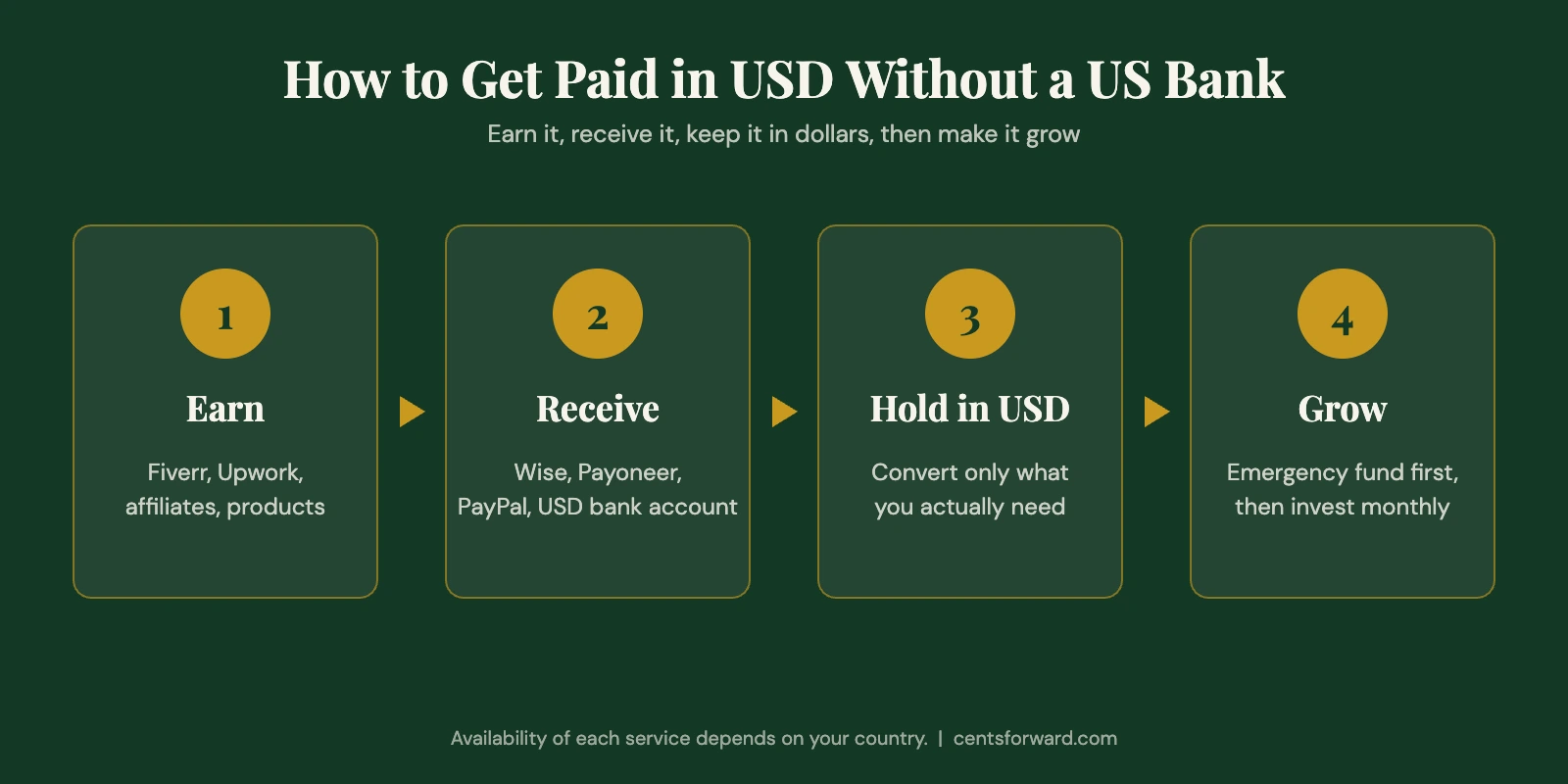
- Wise. In many countries, Wise gives you USD account details you can use to receive payments from platforms and clients. You can hold dollars and convert at the real exchange rate with a small, clear fee. Check which account details are available where you live.
- Payoneer. Widely used by freelancers in the Gulf, Egypt, India and Pakistan. It works with Upwork, Fiverr and many marketplaces, and gives you receiving accounts in several currencies.
- PayPal. Accepted almost everywhere and quick to set up, but currency conversion rates are usually worse. Avoid converting inside PayPal if you can.
- A USD account at your local bank. Many Gulf banks offer USD accounts. This works well for larger direct transfers from clients, though bank wire fees can be high for small amounts.
The key rule: keep your earnings in USD until you actually need another currency. Every unnecessary conversion costs you money. Here is more on managing money in two currencies without losing to fees.
What to Do With Your USD Income
Earning in USD is only half the plan. The other half is keeping and growing it. Most people let extra income disappear into lifestyle spending. A simple order works better.
- Build your safety net first. If you live abroad, losing your job can also mean losing your visa. Here is how big an emergency fund expats really need.
- Decide how much to keep. Use this guide on how much of your income to save to set a clear target.
- Invest the rest every month. Your dollars are already in the right currency for global investing. Follow the step-by-step guide on how to start investing as an expat.
This is how side income turns into long-term wealth: earn in dollars, protect them and invest them.
Common Mistakes When You Start Earning in Dollars
- Trying three methods at once. Pick one method and give it 90 days before judging it.
- Converting every payment straight away. Small conversion fees add up. Hold USD and convert only what you need.
- Ignoring tax. Some countries tax worldwide income. Check the rules where you are tax resident, and keep records of what you earn.
- Spending all of it. Decide in advance what share of your USD income goes to savings and investing.
- Falling for “get rich quick” offers. Real USD income takes consistent work. Anyone promising thousands in your first month is selling something.
Want more ideas? Browse the 50 ways to earn extra money, ranked by earning potential.
Frequently Asked Questions
How can I earn in USD from outside the USA?
You can earn in USD from outside the USA through freelancing on Fiverr or Upwork, affiliate marketing, selling digital products, blogging, online tutoring, newsletters and dividend investing. All of these pay in US dollars and accept non-US residents.
How do I get paid in USD without a US bank account?
Use Wise, Payoneer, PayPal or a USD account at your local bank. Wise and Payoneer can give you account details for receiving USD from clients and platforms, and most freelance and affiliate platforms pay to these services directly.
What is the fastest way to earn in USD?
Freelancing. If you have a marketable skill, you can create a Fiverr or Upwork profile and often earn your first dollar payment within a few weeks, with no audience or upfront investment needed.
Can non-US residents join affiliate programs?
Yes. Most affiliate programs accept members from outside the US. Networks such as Impact, PartnerStack and Awin accept members from the UAE and most other countries and pay in USD.
How much can I earn in USD in the first year?
It depends on the method and your consistency. Freelancing can produce income within weeks, while blogging and newsletters usually take 6 to 12 months before meaningful income appears. Treat the first year as building the asset.
Do I pay tax on USD income earned online?
It depends on your country of tax residence. The UAE has no personal income tax, but many countries tax residents on worldwide income, including online earnings. Check your local rules and keep records of every payment.
The Bottom Line
You do not need to be American to earn in USD. Pick one method from this list, run it consistently for 90 days, get paid through Wise or Payoneer, keep your earnings in dollars and invest a fixed share every month. Your salary has a ceiling. The income you build on the side does not have to.
This article is for education only and is not financial or tax advice. Platform rules and fees change, so check the latest terms before signing up.
[…] regularly moving money between two currencies, whether that’s a salary, rental income, or earning income in USD from anywhere as a freelancer, a multi-currency account changes the math. It lets you hold both currencies at […]