Some links in this post are affiliate links. If you sign up through them, CentsForward may earn a small commission at no extra cost to you. Read the full affiliate disclosure.
You find a fund that looks perfect, then spend three weeks wondering whether it is halal enough. Meanwhile the money sits in a savings account, quietly losing ground to inflation.
This guide is for anyone outside the US who wants to invest in the stock market and keep it Shariah-conscious. We will look at three halal ETFs that non-US investors can actually buy, what each one costs, and a simple way to choose between them.
Quick answer: The simplest halal ETFs for non-US investors are Irish-domiciled UCITS funds that track Shariah-screened indexes. Three well-known examples are the iShares MSCI World Islamic UCITS ETF (ISWD), the HSBC MSCI World Islamic Screened UCITS ETF and the Wahed S&P 500 Shariah UCITS ETF. Pick one global fund for the core of your money, confirm the screening suits your own scholar or standards, and buy it through a broker that accepts residents of your country.
Why Choosing Halal ETFs Feels So Hard
Most investing content is written for Americans, so the funds it recommends are often US-listed products you cannot buy from the UAE. Halal investing adds a second filter on top, and suddenly you are comparing index methodologies at midnight.
There is also a quieter problem. Psychologists call it omission bias, the habit of treating inaction as safer than action even when waiting has a cost. Leaving money in cash feels clean, but inflation takes a small bite every year, and that loss is certain.
What Makes an ETF Halal?
An ETF (exchange-traded fund) is a basket of shares you buy as one product on a stock exchange. A halal ETF is one that tracks an index which has screened out companies the Shariah does not allow.
Index providers usually apply two filters. First, a business screen removes companies whose main income comes from areas such as alcohol, gambling, pork, adult content, conventional banking and insurance. Second, a financial screen removes companies with too much debt or too much interest income compared with their size.
Screening is rules-based, so different providers draw the line in slightly different places. That is why scholars sometimes disagree, and why you should treat any list of halal ETFs as a starting point for your own checks, not a ruling.
3 Halal ETFs Non-US Investors Can Buy
All three funds below are Irish-domiciled UCITS ETFs. UCITS is a European rulebook for funds that gives investors protections and makes the funds available to people outside the US. If the term is new, my guide to UCITS ETFs for non-US investors explains it in plain language.
These are examples for research, not personal recommendations. Always check the latest factsheet before you buy.
1. iShares MSCI World Islamic UCITS ETF (ISWD)
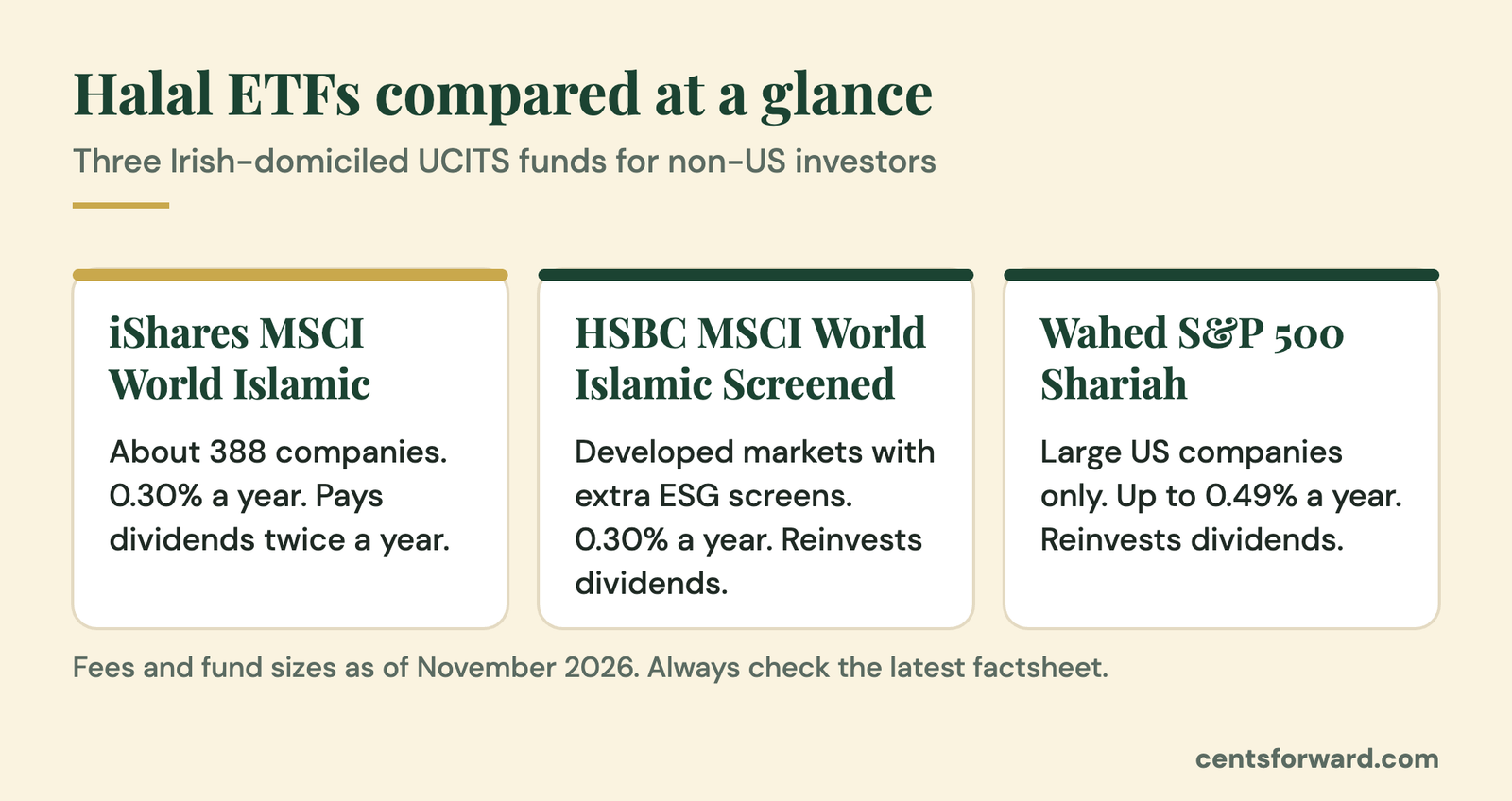
This is the largest and longest-running option. According to BlackRock’s fund page, it tracks the MSCI World Islamic Index, holds about 388 companies from developed markets, charges an ongoing fee of 0.30% a year, and manages roughly $1.6 billion. It has been running since 2007.
It is a distributing fund, which means it pays out dividends twice a year instead of reinvesting them. That suits you if you want income, and it gives you a clear number to use when you purify your earnings.
2. HSBC MSCI World Islamic Screened UCITS ETF (Acc)
This fund also covers developed markets, but it is built on a different index: the MSCI World Custom Islamic ESG Universal Screened Index, which adds environmental, social and governance screens on top of the Shariah rules. The ongoing fee is also 0.30% a year, and the share class is accumulating, so dividends are reinvested for you.
The trade-off is size and history. ETF Stream’s data showed about $85 million in the fund in late 2025, so it is much younger and smaller than ISWD. That is not a red flag by itself, but check how easily it trades before you buy.
3. Wahed S&P 500 Shariah UCITS ETF (Acc)
This one is narrower. It follows the S&P 500 Shariah Index, so you only own large US companies, and the fund documents describe it as managed in reference to the index rather than copying it exactly. The share class is accumulating, in US dollars, and the fund supplement lists total costs of up to 0.49% a year.
It launched in 2025, so the track record is short. It makes sense as a smaller addition if you want extra US exposure, not as your only holding.
Halal ETFs Compared Side by Side
| Fund | Covers | Yearly cost | Dividends | Size |
|---|---|---|---|---|
| iShares MSCI World Islamic | Developed markets, about 388 companies | 0.30% | Paid out twice a year | About $1.6 billion |
| HSBC MSCI World Islamic Screened | Developed markets, extra ESG screens | 0.30% | Reinvested | About $85 million (late 2025) |
| Wahed S&P 500 Shariah | Large US companies only | Up to 0.49% | Reinvested | New fund, short history |
Fees, fund sizes and holdings change, so treat this table as a snapshot from November 2026. The fund provider’s own page is always the final word.
How to Choose Between Halal ETFs
You do not need the perfect fund. You need a good one that you will actually keep buying for twenty years.
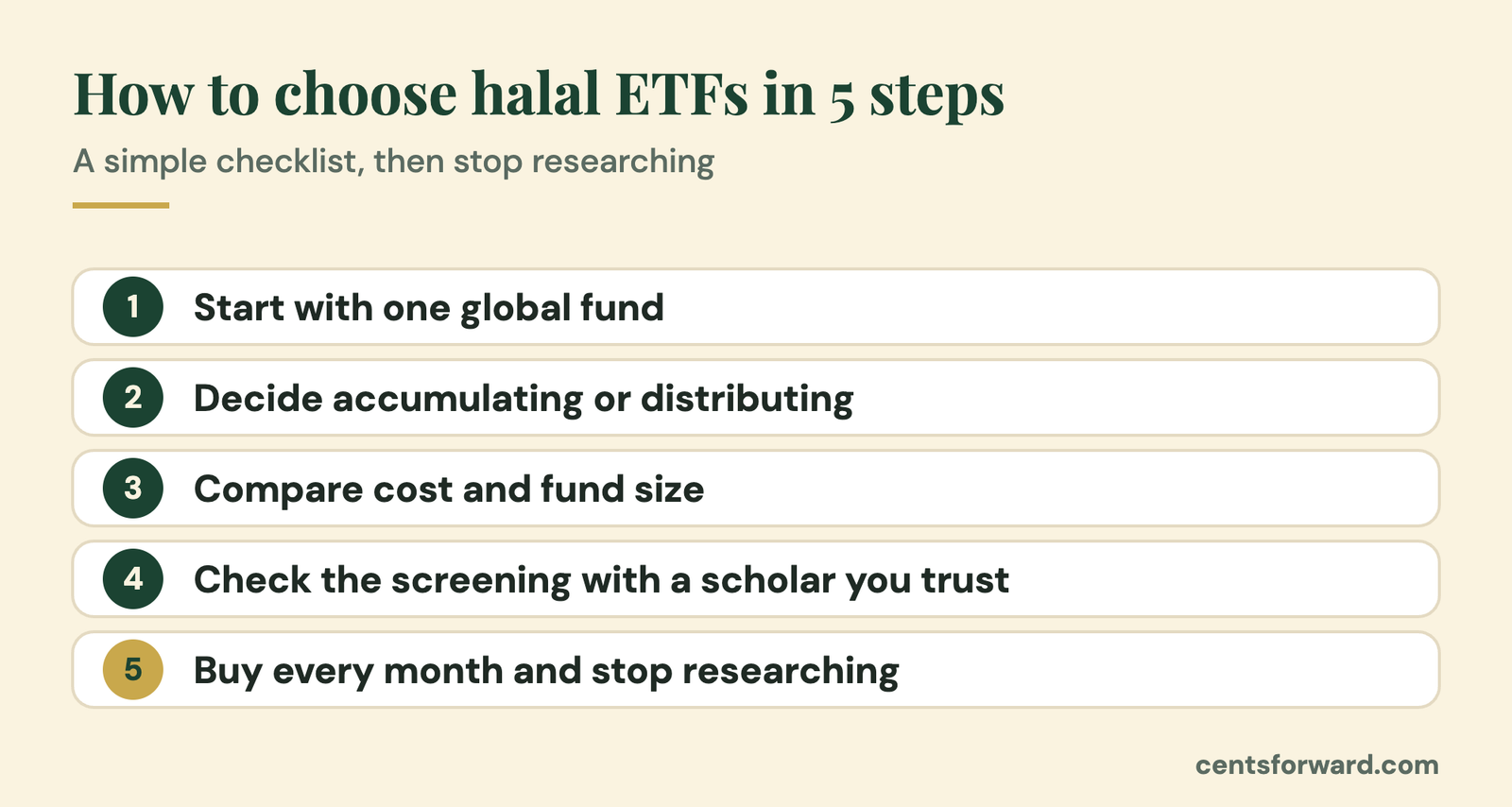
- Start with one global fund. A world fund spreads your money across many countries and hundreds of companies, which is the whole point of diversification. A US-only fund is a bet on one market.
- Decide accumulating or distributing. If you are building wealth and do not need income, accumulating funds keep things simple. My guide to accumulating vs distributing ETFs walks through the choice.
- Compare cost and size. A lower yearly fee helps, but so does a fund that is big enough to trade smoothly and unlikely to be closed.
- Check the screening against your standards. Read the index rules, or ask a scholar you trust. Different methodologies are all attempts at the same goal, so pick the one you are comfortable with.
- Then stop researching. Once a fund passes steps one to four, the extra hours add almost nothing.
The rule to remember
A good halal ETF bought every month beats a perfect halal ETF you are still researching next year.
Purification, Zakat and Tax
Even a screened fund can hold companies that earn a small share of income from non-compliant sources. Purification means calculating that portion of your dividends or gains and giving it to charity, and many scholars recommend it. A distributing fund makes the dividend part easier to calculate, but methods differ, so confirm yours with a scholar.
Zakat is separate. It is calculated on your wealth when it reaches the nisab and a lunar year passes, and holding an ETF does not replace it.
For tax, Irish-domiciled funds are popular with non-US investors because the US withholding tax on dividends inside the fund is usually 15%, not the 30% you may face on US shares held directly. I break this down in do expats pay tax on investments. For a comparison of global funds more broadly, see VWRA vs VWRP.
How to Buy Halal ETFs From Abroad
You need a broker that accepts residents of your country and lists London-traded UCITS funds. Interactive Brokers does both, and its signup includes the W-8BEN form that tells the US you are not an American taxpayer.
You can open an Interactive Brokers account here, and this guide shows how to open an Interactive Brokers account from abroad step by step. If you prefer a simpler app, eToro also accepts non-US residents and offers an Islamic account option, though you should confirm that a specific fund is available on the platform before you commit.
Whichever you choose, keep it a plain cash account. Avoid margin, avoid short selling and skip any feature that pays you interest, so the structure stays as clean as the fund. If you are still comparing platforms, read my comparison of the best brokers for non-US investors.
Once you own a fund, the habit that matters is buying it regularly. The guide to starting investing as an expat shows how to build that routine.
Frequently Asked Questions
Are halal ETFs really halal?
Halal ETFs track indexes screened against Shariah rules on business activity and finances, which makes them far closer to compliant than a standard index fund. No screen is perfect, and scholars differ on methods, so confirm the standard that matches your own scholar or school.
What is the best halal ETF for beginners outside the US?
A broad, low-cost, Irish-domiciled world fund is usually the simplest starting point, such as the iShares MSCI World Islamic UCITS ETF or an accumulating alternative. The best choice is the one that fits your standards and that you will keep buying monthly.
Can UAE residents buy halal ETFs?
Yes. UAE residents can buy UCITS halal ETFs through brokers that accept them, such as Interactive Brokers. Funds listed in London trade in US dollars, which also avoids repeated currency conversion.
Do I pay tax on halal ETFs in the UAE?
The UAE has no personal income tax, so individuals pay no UAE tax on dividends or gains from their own investments. Withholding tax inside the fund and your home country’s rules can still apply, so check your own situation.
Should I choose an accumulating or distributing halal ETF?
If you are building wealth for the long term, accumulating funds reinvest dividends automatically and keep things simple. Distributing funds suit people who want regular income or who prefer to calculate and purify dividends themselves.
The Bottom Line
Halal ETFs are no longer a niche product you have to work around. A global, low-cost, Shariah-screened UCITS fund bought every month puts your money to work while you keep your principles.
Pick one fund this week, confirm the screening with someone you trust, and make the first purchase. Want one practical investing tip for non-Americans every week? Join the free CentsForward newsletter.
This article is for education only and is not financial, religious or tax advice. Fund details change, so check the latest factsheet and consult a qualified professional and a scholar you trust before investing.
Keep reading
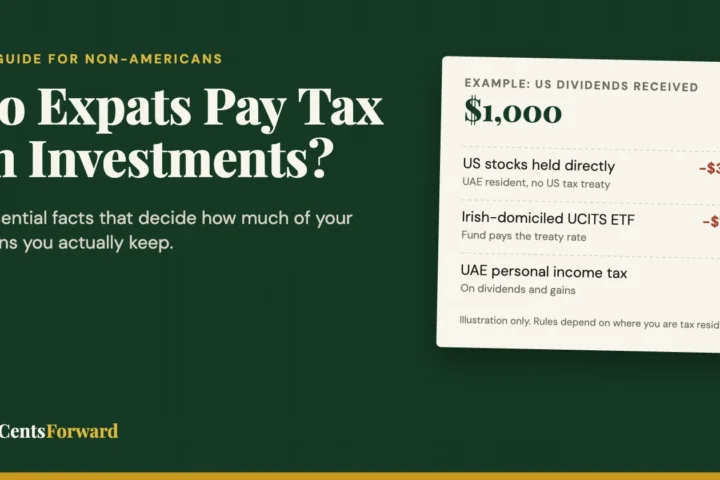
Do Expats Pay Tax on Investments? 7 Essential Facts to Avoid Costly Mistakes
Do expats pay tax on investments? Here is how residency, US withholding and estate tax really work for non-Americans, and how to keep more of your returns.
Accumulating vs Distributing ETFs: Best Halal Pick 2026
You finally pick a halal ETF, open your broker app, and two versions show up with the same companies inside and almost the same fee. One...
How to Invest Your End of Service Gratuity (Halal, Step by Step)
Your gratuity might be the largest single payment of your expat career. Here's a 5-step halal plan to put it to work instead of letting it sit idle.