Disclosure: some links in this post are referral links. If you open an account through them, CentsForward may earn a commission at no extra cost to you. Read the full affiliate disclosure.
Your portfolio is finally growing, and then a colleague mentions tax over lunch. Suddenly you are not sure whether you owe something somewhere, for money you thought was simply yours.
So, do expats pay tax on investments? Sometimes yes, sometimes no, and the answer depends on three things most guides never explain clearly.
This guide breaks it down in plain language for anyone investing from outside the US: what gets taxed, who taxes it, and how to keep more of your returns legally.
The short answer: Do expats pay tax on investments? It depends on where you are tax resident, where your investments are based, and the size of any US assets you hold.
If you live in the UAE, you pay no personal tax on dividends or gains, but the US still withholds 30% of US dividends paid to you directly. Irish-domiciled UCITS ETFs cut that to 15% and avoid US estate tax.
In this guide:
- The 3 Taxes That Decide Whether Expats Pay Tax on Investments
- Do Expats Pay Tax on Investments? 7 Essential Facts
- Why Tax Fear Keeps Expats From Investing
- How to Pay Less Tax on Your Investments Legally
- Halal Investing and Tax: What Changes
- Frequently Asked Questions
The 3 Taxes That Decide Whether Expats Pay Tax on Investments
Three different places can take a share of your investment returns. Whenever someone asks “do expats pay tax on investments,” the real answer depends on these three, so check each one.
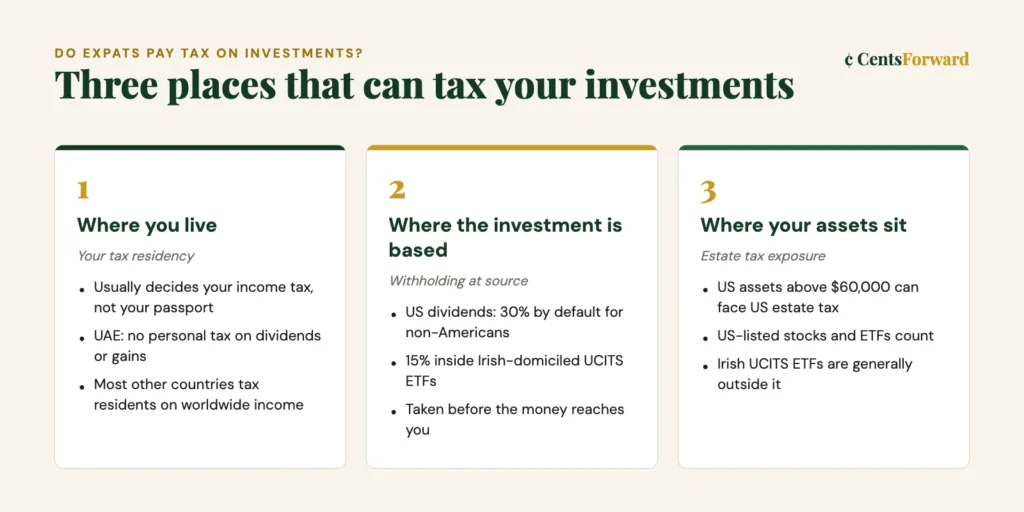
1. Tax where you live (residency tax)
Tax residency means the country that has the right to tax your income, usually where you live most of the year. For most people, this decides your income tax, not your passport. Most countries tax their residents on income earned anywhere in the world.
2. Tax where the investment is based (withholding tax)
Withholding tax is taken by the country where a company is based, before a dividend ever reaches you. You cannot avoid it by living somewhere tax-free, because it is deducted at the source.
3. Tax on assets when you die (estate tax)
Estate tax is charged on what you leave behind. The US can apply it to non-Americans who hold US assets, which surprises many expats who only buy US shares.
Do Expats Pay Tax on Investments? 7 Essential Facts
Fact 1: Residency usually matters more than your passport
Most countries tax you based on where you live, not your nationality. The big exception is the United States, which taxes its citizens wherever they live. If you are not American, your tax residency is the starting point.
Fact 2: The UAE does not tax your personal investment income
The UAE has no personal income tax, so individuals pay no UAE tax on dividends or capital gains from their own investments. That is a real advantage, but it only covers UAE tax.
For UAE residents, the question “do expats pay tax on investments” is really about other countries’ rules, especially the US.
Fact 3: The US takes 30% of US dividends by default
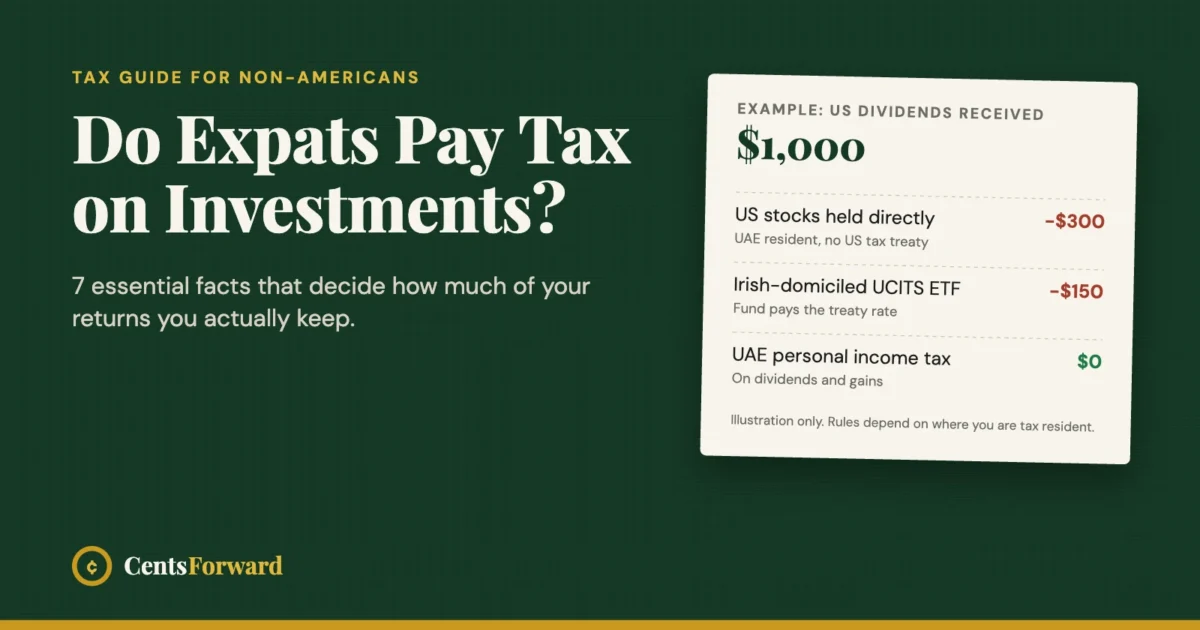
When a US company pays a dividend to a non-American, the US withholds 30% unless a tax treaty lowers it. The UAE has no income tax treaty with the US, so UAE residents holding US stocks directly usually lose the full 30%. On $1,000 of dividends, that is $300 gone before you see it.
Fact 4: Irish-domiciled ETFs cut that to 15%
Ireland has a treaty with the US, so an Irish-domiciled UCITS ETF pays only 15% on the US dividends it receives. Ireland generally does not add its own withholding when the fund pays non-Irish investors. I explain how these funds work in UCITS ETFs explained for non-US investors.
Fact 5: US capital gains are generally not taxed for non-residents
This is where the answer to “do expats pay tax on investments” surprises people most. If you are not a US citizen or resident, the US generally does not tax the profit when you sell US shares, as long as you are not physically in the US for 183 days or more that year. Your own country of residence may still tax that gain.
Fact 6: US estate tax can hit US assets above $60,000
The IRS says non-residents whose US assets exceed $60,000 may need to file a US estate tax return, and US company shares count. Irish UCITS ETFs are generally not treated as US assets, which is a major reason expats choose them.
Fact 7: Leaving your home country does not always end your tax residency
Some countries keep treating you as tax resident until you meet specific conditions, such as day counts or closing ties. If you are still tax resident there, your foreign accounts can be reported to that country under the Common Reporting Standard (CRS), an international system for sharing bank and broker data between tax authorities.
So before you answer “do expats pay tax on investments” for yourself, confirm where you are really tax resident.
Do expats pay tax on investments? A $1,000 example
US stocks held directly by a UAE resident: about $700 reaches you. Through an Irish UCITS ETF: about $850 stays invested. UAE personal tax on either: $0.
Why Tax Fear Keeps Expats From Investing
Not knowing the answer to “do expats pay tax on investments” feels like risk, so many people respond by doing nothing. They leave money in a savings account for years because they are afraid of a tax mistake they cannot even describe.
Doing nothing also has a cost. Inflation quietly eats idle cash every year, and that loss is guaranteed. A 15% or even 30% tax on dividends still leaves you far ahead of money that never got invested.
Most people who search “do expats pay tax on investments” are really asking whether investing is still worth it. It is, by a wide margin.
How to Pay Less Tax on Your Investments Legally
Once you know how these rules apply to you, these steps keep your tax bill as small as the law allows.
- Confirm your tax residency. Know which country can tax you, and whether your home country still treats you as resident.
- Submit Form W-8BEN with your broker. The W-8BEN certifies that you are not a US person. Without it, a broker may withhold more than necessary. It usually needs renewing every three years.
- Prefer Irish-domiciled UCITS ETFs over US-listed funds. You pay 15% instead of 30% on US dividends and avoid US estate tax exposure.
- Consider accumulating funds. If you do not need the income yet, funds that reinvest dividends keep things simple. Here is how to choose between accumulating and distributing ETFs.
- Keep simple records. Save your annual broker statements. If you move countries, you may need them to prove what you paid and when.
- Get advice before you relocate. Moving can change your tax position overnight, so speak to a qualified adviser before you sell large positions or move.
Your broker matters too. Interactive Brokers accepts non-US residents, handles the W-8BEN during signup, and lists most Irish UCITS ETFs on the London Stock Exchange.
You can open an Interactive Brokers account here. If you prefer a simpler app, eToro also accepts non-US residents and offers an Islamic account option. Stick to real shares and ETFs there, not CFDs.
Still choosing? My comparison of the best brokers for non-US investors covers fees and market access, and this step-by-step guide shows how to open an Interactive Brokers account from abroad.
Halal Investing and Tax: What Changes
Halal investors asking “do expats pay tax on investments” face the same rules as everyone else, because Shariah-screened funds are taxed like any other fund.
Domicile still matters. Irish-domiciled options such as iShares MSCI World Islamic (ISWD), iShares MSCI USA Islamic (ISUS) and iShares MSCI Emerging Markets Islamic (ISDE) get the 15% treaty rate. These are examples for research, not recommendations.
Zakat is separate from tax. Paying withholding tax does not replace your zakat obligation, and many scholars recommend purifying the small part of dividends linked to non-compliant income. If dividends are your focus, read my guide to dividend investing for beginners outside the US.
Frequently Asked Questions
Do expats pay tax on investments in the UAE?
No UAE personal tax applies to dividends or capital gains from your own investments. However, the country where an investment is based may still withhold tax, such as the 30% the US takes from dividends paid directly to UAE residents.
Do expats pay tax on investments in their home country?
Only if their home country still treats them as tax resident, or taxes by citizenship like the US. Rules differ a lot, so check your home country’s residency conditions before assuming you are free of them.
Do I pay US tax when I sell US stocks as a non-American?
Generally no. Non-residents are usually not taxed by the US on capital gains from selling US shares, unless they spend 183 days or more in the US that year. Your country of residence may still tax the gain.
Do expats pay tax on investments in other Gulf countries?
Most Gulf countries do not currently tax individuals on personal investment income, but rules are changing. Oman, for example, has announced a personal income tax on high earners starting in 2028. Check the current rules where you live.
Do expats pay tax on investments through eToro or Interactive Brokers?
The broker does not change the tax rules. What matters is where you are tax resident and where your funds are domiciled. A good broker simply makes it easier by handling your W-8BEN and offering Irish UCITS ETFs.
Is zakat the same as tax on investments?
No. Zakat is a religious obligation calculated on your wealth, while tax is set by governments. Paying one does not cancel the other.
The Bottom Line
Do expats pay tax on investments? Yes, sometimes, but rarely as much as people fear, and usually less once you choose the right funds and fill in one form.
Sort out your residency, use Irish UCITS ETFs, file your W-8BEN, and then focus on what actually builds wealth: investing every month. If you have not started yet, here is how to start investing as an expat.
Want one practical investing tip for non-Americans every week? Join the free CentsForward newsletter.
This article is for education only and is not financial or tax advice. Tax rules change and depend on your personal situation, so check with a qualified professional before making decisions.
Keep reading
Halal ETFs: 3 Best UCITS Picks for Non-US Investors
Looking for halal ETFs outside the US? Compare 3 Irish-domiciled UCITS picks, their fees and screening, and learn how to choose one with confidence.
Accumulating vs Distributing ETFs: Best Halal Pick 2026
You finally pick a halal ETF, open your broker app, and two versions show up with the same companies inside and almost the same fee. One...
How to Invest Your End of Service Gratuity (Halal, Step by Step)
Your gratuity might be the largest single payment of your expat career. Here's a 5-step halal plan to put it to work instead of letting it sit idle.